Glechoma, Genus, hederacea, Species,
- Genus & species
Ground ivy
Overview
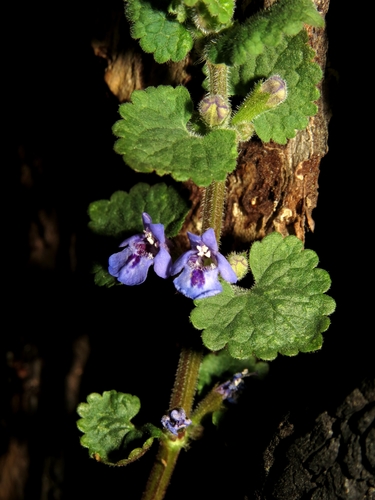
Glechoma hederacea is a low, creeping perennial in the mint family that forms dense mats 2-4 inches (5-10 cm) tall, spreading by rooting stolons that extend 12-24 inches (30-60 cm) in a season. The square stems carry opposite, kidney-shaped to rounded leaves 0.4-1.2 inches (1-3 cm) across, with scalloped margins and a network of veins; crushed foliage releases a sharp, minty scent. From early spring into summer it bears small two-lipped flowers 0.4-0.9 inch (1-2.2 cm) long in clusters of two to four in the leaf axils, ranging from blue to violet with darker purple spotting on the lower lip. The plant spreads both by seed and by stolons that root at the nodes, colonizing lawns, shaded borders, and disturbed ground. It tolerates a wide range of soils and light conditions but grows fastest where soil stays moist and shade is partial. Because it roots at every node, fragments left after weeding regenerate into new plants, and it is classed as a weed in lawns and beds across much of its naturalized range. Foliage stays green through mild winters in temperate zones and dies back where winters are severe. Contact with the sap causes mild skin irritation in some people, and the plant contains compounds toxic to horses if grazed in quantity.
Native Range
Glechoma hederacea is native to Europe and western Asia. It has naturalized widely across North America, where it grows in lawns, woodland edges, and moist disturbed ground, and is treated as invasive in several US states and Canadian provinces.Suggested Uses
Glechoma hederacea is sometimes grown as a groundcover in shaded areas and in hanging containers, where the trailing stems spill over the edges; variegated forms are sold for this use. In most gardens it appears as a volunteer weed in lawns and beds rather than a planted species. Its spreading habit suits it to areas where a dense, low mat is wanted and containment is possible.How to Identify
Appearance
Size & Dimensions
Height2" - 4"
Width/Spread1' - 2'
Bloom Information
Flowering runs from early spring through early summer, typically March to June depending on latitude. The two-lipped blue-violet flowers, 0.4-0.9 inch (1-2.2 cm) long, open in small axillary clusters and are visited by long-tongued bees. Bloom tapers as summer heat sets in, though scattered flowers may appear later in cool, moist conditions.
Detailed Descriptions
Flower Description
blue to violetFoliage Description
greenGrowing Conditions
Sun Requirements
Requires 2-8 hours of direct sunlight daily
• Full Sun: 6+ hours of direct sunlight
• Partial Shade: 3-6 hours of direct sunlight
• Full Shade: Less than 3 hours of direct sunlight
Care & Maintenance
Care Guide
Glechoma hederacea grows in full sun to full shade and tolerates most soils, from clay to sandy loam, where some moisture is retained. It spreads fastest in partial shade with consistent moisture and slows in dry, sunny sites. No fertilizing or watering is needed once established, as the plant draws on a shallow, fibrous root system. Because it roots at every stem node, it moves into surrounding turf and beds and can overtake slower groundcovers. Mowing reduces flowering but does not stop the stolons from spreading. Hand-pulling removes plants only where the rooted nodes and stolon fragments are lifted with them.Pruning
Mowing or shearing in spring removes flowering stems and limits seed set. Stolons that escape into lawns or borders can be lifted by hand, with the rooted nodes taken up, since fragments regrow. Repeated removal over a season is usually needed to reduce an established patch.Pruning Schedule
Prune: April–May
spring
Container Growing
Suitable for container growing
Minimum container size: 1 gallons