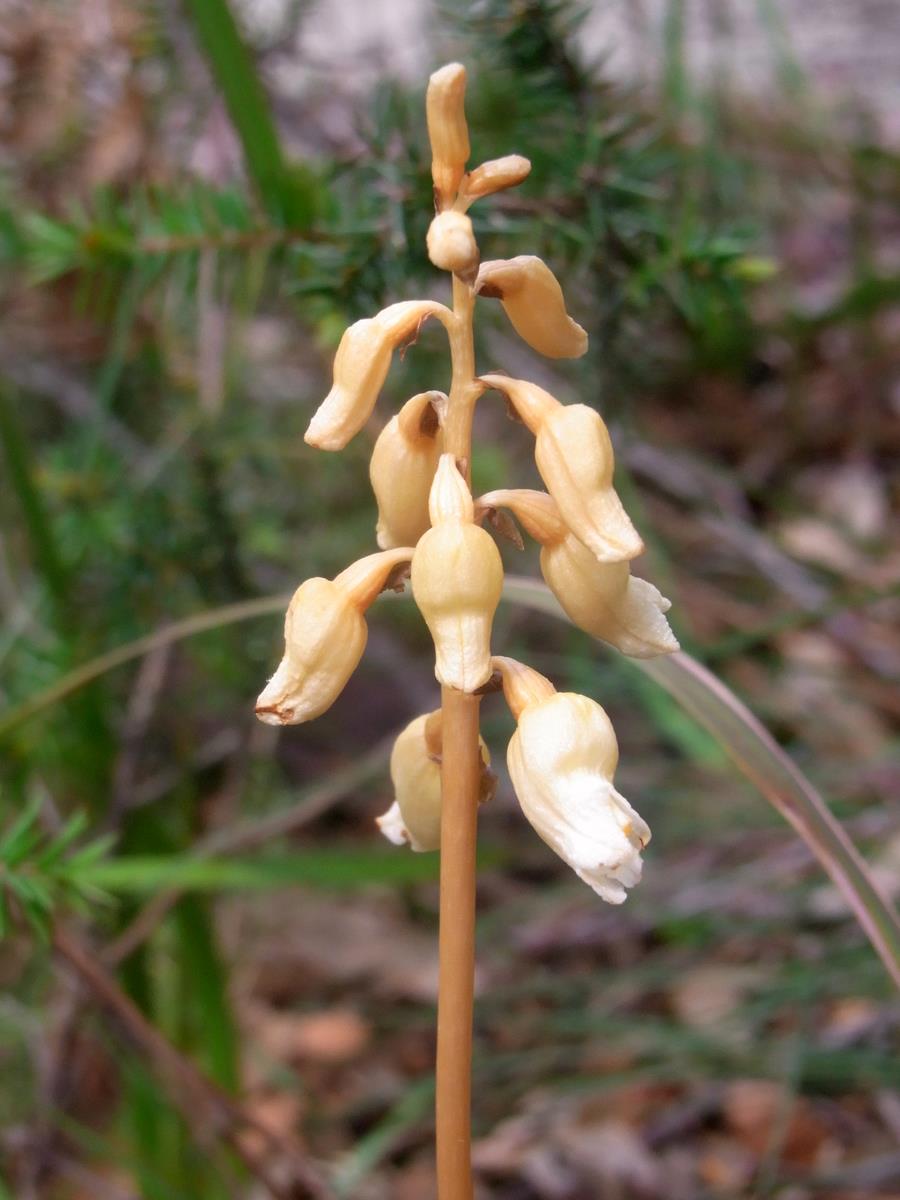
Gastrodia, Genus, spp., Multiple species,
- Genus
- Multiple species
potato orchid
Asia, Australasia, the Pacific, Madagascar, and tropical Africa
SunFull Shade – Part Shade
WaterMedium
Overview
Gastrodia is a genus of about 100 leafless terrestrial orchids in the family Orchidaceae, distributed across Asia, Australia, New Zealand, the Pacific islands, Madagascar, and tropical Africa. The plants contain no chlorophyll and produce no true leaves; instead they obtain all their carbon from soil fungi, a nutritional mode called mycoheterotrophy, with many species linked to honey fungus (Armillaria). Below ground each plant forms a fleshy tuber or coralloid rhizome, the origin of the potato orchid common name. For most of the year there is nothing visible above the soil. At flowering a single unbranched stem rises 8-40 inches (20-100 cm) and carries a raceme of small urn- or bell-shaped flowers fused into a tube, colored in muted brown, tan, fawn, and cream rather than bright hues. Because the plants depend on a specific fungal partner, they cannot be transplanted or grown by ordinary horticulture and are encountered mainly in the wild. G. elata is collected in East Asia for traditional medicine, and G. sesamoides is widespread in Australian forests. The dependence on intact fungal networks makes the genus sensitive to soil disturbance.
Native Range
Gastrodia is native to a broad belt across eastern and southern Asia, Australia, New Zealand, the Pacific islands, Madagascar, and tropical Africa. Species grow on shaded forest floors and woodland where the fungi they depend on are present.Suggested Uses
This genus is not used in conventional gardens because it cannot be cultivated without its fungal partner. It is of interest in native woodland conservation and in the study of mycoheterotrophic plants. G. elata is grown semi-wild in parts of East Asia for medicinal tuber production.How to Identify
Appearance
Size & Dimensions
Height8" - 3'4"
Width/Spread2" - 4"
Bloom Information
Flowering time varies with species and climate, falling mainly in spring and summer. The leafless flowering stem appears, blooms over 2-4 weeks, sets seed in dry capsules, and withers, after which the plant returns underground. Outside this brief period the plants leave no visible trace.
Detailed Descriptions
Flower Description
brown, tan, fawn, creamGrowing Conditions
Sun Requirements
Tolerates up to 2 hours of direct sunlight daily
• Full Sun: 6+ hours of direct sunlight
• Partial Shade: 3-6 hours of direct sunlight
• Full Shade: Less than 3 hours of direct sunlight
Water & Climate
Water Needs
