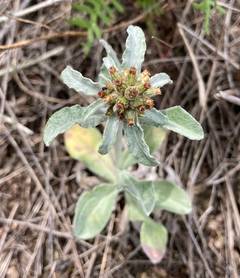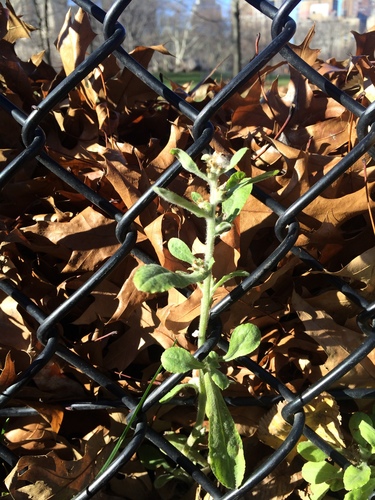
Gamochaeta, Genus, pensylvanica, Species,
- Genus & species
Pennsylvania cudweed
SunFull Sun – Part Shade
Overview
Gamochaeta pensylvanica, Pennsylvania cudweed, is a low annual or short-lived herb of the daisy family, growing 4-20 inches (10-50 cm) tall on erect to spreading, white-woolly stems. The leaves are spoon-shaped to oblong, 1-3 inches (2.5-8 cm) long, green and thinly hairy above and densely grey-woolly beneath. From spring through fall it produces small, brownish flower heads about 0.2 inch (4-5 mm) long, clustered in leafy spikes at the stem tips and in the upper leaf axils. The heads contain only tiny tubular disk florets, with no showy ray petals, and are wrapped in papery, straw-brown bracts. Wind-borne seeds with slender bristles disperse widely. G. pensylvanica grows in lawns, gardens, fields, roadsides, and other disturbed ground, often in moist, sandy, or compacted soil. It completes its cycle quickly and self-sows freely, and is treated chiefly as a lawn and garden weed.
Native Range
Native to the warmer parts of the Americas and now naturalized across much of the world tropics and subtropics. In North America it is common in the southeastern and southern United States, growing in lawns, gardens, fields, and disturbed ground.Suggested Uses
G. pensylvanica is not grown as an ornamental and is encountered as a volunteer weed in lawns, gardens, and disturbed sites. It has minor value as larval food for some butterfly and moth species. It is otherwise managed rather than planted.How to Identify
Appearance
Size & Dimensions
Height4" - 1'8"
Width/Spread4" - 1'
Bloom Information
Small brownish flower heads form over a long season, from spring through fall in mild climates and through summer farther north. The heads hold only inconspicuous disk florets and never open into showy blooms. Seed set follows quickly, so flowering and seeding overlap for months.
Detailed Descriptions
Foliage Description
green above, grey-woolly beneathGrowing Conditions
Sun Requirements
Requires 4-10 hours of direct sunlight daily
• Full Sun: 6+ hours of direct sunlight
• Partial Shade: 3-6 hours of direct sunlight
• Full Shade: Less than 3 hours of direct sunlight
Water & Climate
Water Needs
Drought Tolerance
Drought tolerant when established
Care & Maintenance
Care Guide
As a weedy annual, it needs no cultivation and germinates readily in moist, disturbed, or compacted soil in sun to part shade. It tolerates poor ground, foot traffic, and mowing, regrowing from the base in turf. Where it is unwanted, hand-pulling or hoeing before seed set is the simplest control, since the plant has a shallow root system. Dense, healthy turf and mulch limit its establishment. No watering or feeding is required. Each plant sheds abundant wind-blown seed, so removing plants before the heads mature reduces future seedlings.Pruning
No pruning is needed for this short-lived plant. Where control is wanted, plants are pulled or hoed before the flower heads ripen and release seed. Mowing slows but does not stop seeding, as low rosettes can flower below the blade.Toxicity
Non-toxicPlanting Guide
Planting Methods & Timing
Planting Method
direct sow
Direct Sow Timing
self-sows in spring
Days to Maturity
50–80 days
Plant Spacing
8 inches