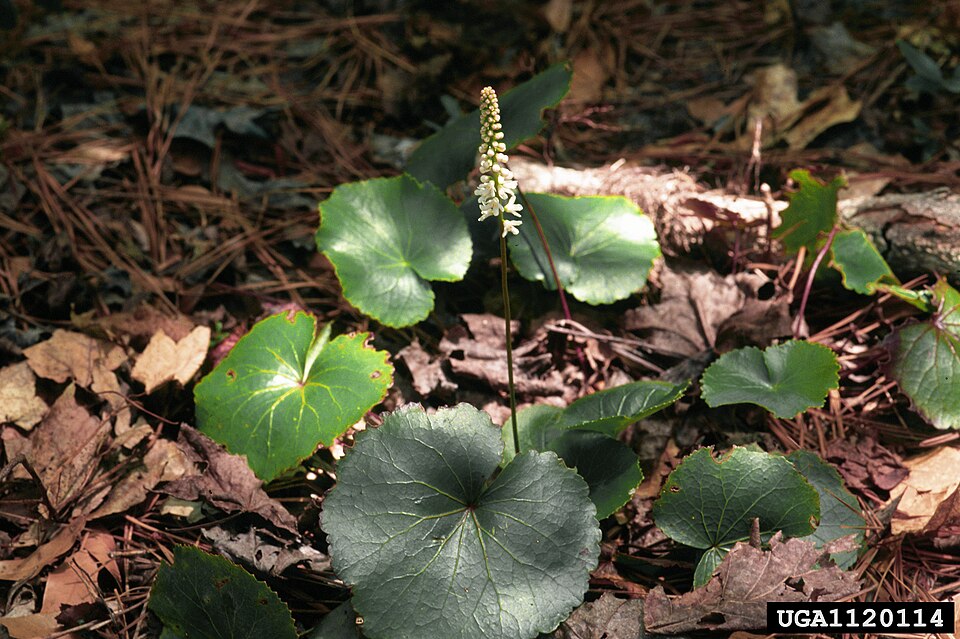
© Ted Bodner, Southern Weed Science Society, Bugwood.org, some rights reserved (CC-BY) · Wikimedia Commons
Galax, Genus, spp., Multiple species,
- Genus
- Multiple species
galax
Southern Appalachian Mountains, southeastern United States
Overview
Galax is a genus in the family Diapensiaceae containing the single species Galax urceolata, known as galax, beetleweed, or wandflower, an evergreen perennial native to the woodlands of the southern Appalachian Mountains in the eastern United States. Plants form low, spreading colonies from creeping rhizomes, with rounded, heart-shaped, glossy, leathery leaves 2-5 inches (5-13 cm) wide held on long stalks. The dark green leaves turn bronze to deep red in winter, especially in sun, and are widely harvested for use as cut foliage in the florist trade. In late spring and summer, slender leafless stalks 8-16 inches (20-40 cm) tall rise above the foliage, each carrying a narrow spike of many tiny white flowers. Galax grows in acidic, humus-rich soil in shade to part shade, spreading slowly into an evergreen groundcover. It is slow to establish and needs cool, moist, acidic woodland conditions, and it grows poorly in heavy, alkaline, or dry soils. Over-collection of wild foliage has raised conservation concern in parts of its range.
Native Range
Galax is native to the southeastern United States, centered on the southern Appalachian Mountains from Virginia and West Virginia south to Georgia and Alabama. It grows in acidic forest soils, on slopes, and along stream banks.Suggested Uses
Galax is grown as an evergreen groundcover in shaded and woodland gardens, on acidic banks, and along shaded paths, valued for glossy foliage and winter color. It is used as an edging and underplanting beneath rhododendrons and other acid-loving shrubs. The leaves are also cut for use as long-lasting floral greenery.How to Identify
Appearance
Size & Dimensions
Height8" - 1'4"
Width/Spread1' - 2'
Bloom Information
Detailed Descriptions
Foliage Description
glossy green, bronze-red in winterGrowing Conditions
Sun Requirements
Tolerates up to 4 hours of direct sunlight daily
• Full Sun: 6+ hours of direct sunlight
• Partial Shade: 3-6 hours of direct sunlight
• Full Shade: Less than 3 hours of direct sunlight
Care & Maintenance
Care Guide
Galax grows in part shade to full shade in cool, moist, acidic, humus-rich soil, reflecting its Appalachian woodland origin. It is slow to establish and spreads gradually by rhizomes once settled, eventually forming a dense evergreen groundcover. Plants are propagated by division or seed, both of which are slow. A mulch of leaf litter keeps the roots cool and the soil acidic and moist. It grows poorly in alkaline, heavy, dry, or sunny sites, where leaves scorch and plants languish. Few pests or diseases affect it.Pruning
Little pruning is needed beyond removing tattered or winter-burned leaves in spring. Spent flower stalks are cut back after bloom. Foliage harvested for arrangements is cut sparingly so colonies are not weakened.Container Growing
Suitable for container growing
Minimum container size: 2 gallons