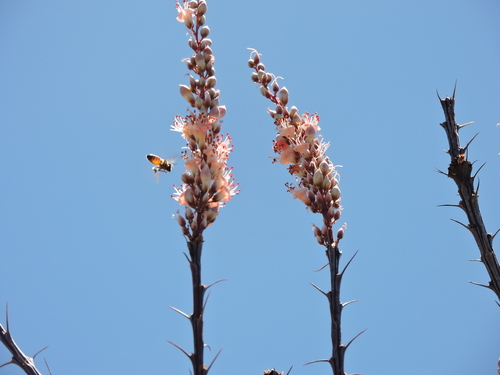
Fouquieria, Genus, spp., Multiple species,
- Genus
- Multiple species
ocotillo
Deserts of Mexico and the southwestern United States
Overview
Fouquieria is a genus of about 11 species of spiny, drought-deciduous desert shrubs and trees in its own family (Fouquieriaceae), native to the arid regions of Mexico and the southwestern United States. The most familiar species, F. splendens (ocotillo), forms a fountain of long, slender, thorn-studded canes 6-20 feet (1.8-6 m) tall rising from a short basal trunk, while F. columnaris (boojum tree) develops a tall, tapering, columnar trunk to 50-65 feet (15-20 m). The stems bear stout spines and produce small leaves quickly after rain, then shed them as the soil dries, repeating the cycle several times a year. Clusters of tubular flowers in red, orange, yellow, or cream open at the cane tips, mainly in spring, and are pollinated by hummingbirds and carpenter bees. The fleshy-barked stems store water and carry out photosynthesis when leafless. Plants are slow-growing and adapted to heat, intense sun, and prolonged drought, but they rot quickly in wet or poorly drained soil and the more tender species are damaged by hard frost.
Native Range
Fouquieria is native to the deserts and dry scrublands of Mexico and the southwestern United States, with its center of diversity in Mexico. F. splendens ranges across the Sonoran, Chihuahuan, and Mojave deserts of the southwestern United States and northern Mexico, while F. columnaris is largely restricted to the Baja California peninsula.Suggested Uses
Fouquieria is grown in desert, xeriscape, and rock gardens and as a living fence, where the spiny canes of ocotillo are sometimes planted in rows. The spring flowers draw hummingbirds to wildlife and pollinator plantings. The boojum tree is grown as a sculptural specimen in large dry gardens and collections, given its slow growth and eventual height.How to Identify
Appearance
Size & Dimensions
Height6' - 65'
Width/Spread6' - 15'
Bloom Information
Flowering occurs mainly in spring, from about March to June, and may repeat after summer rains. The tubular red, orange, or yellow flowers are clustered at the stem tips and are pollinated by hummingbirds, carpenter bees, and migrating nectar feeders. Bloom is heaviest when winter and spring rains have been adequate.
Detailed Descriptions
Flower Description
red, orange, yellow, or creamFoliage Description
greenGrowing Conditions
Sun Requirements
Requires 8-12 hours of direct sunlight daily
• Full Sun: 6+ hours of direct sunlight
• Partial Shade: 3-6 hours of direct sunlight
• Full Shade: Less than 3 hours of direct sunlight
Care & Maintenance
Care Guide
Fouquieria grows in full sun and fast-draining, gritty or rocky soil, and tolerates extreme heat and prolonged drought once established. Sharp drainage is essential, as the water-storing stems rot in wet or heavy ground. Plants are slow-growing and are raised from seed or, in F. splendens, from cane cuttings set directly in the ground. Watering is needed only during establishment and occasionally in the hottest months; established plants are watered sparingly. Bare-root ocotillo transplants are slow to re-root and may not leaf out for a season. The more tender species are damaged by hard frost.Pruning
Pruning is rarely needed beyond removing dead or frost-damaged canes at the base. Live canes are not headed back, as cuts heal slowly in the dry climate and spoil the natural fountain form. Spent flower clusters are left to set seed or trimmed off as they fade.Container Growing
Suitable for container growing
Minimum container size: 7 gallons
