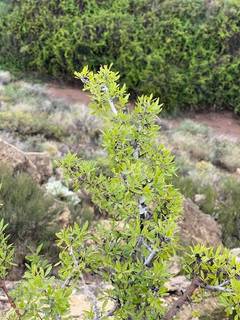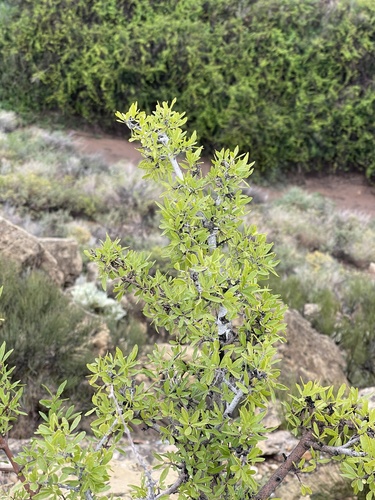
Forestiera, Genus, spp., Multiple species,
- Genus
- Multiple species
swamp privet
Americas: southern US, Mexico, Caribbean, Central and South America
Overview
Forestiera is a genus of about 15 species of deciduous and evergreen shrubs and small trees in the olive family (Oleaceae), native to the Americas from the southern United States through Mexico and the Caribbean to South America. Plants range from 6 to 25 feet (1.8-7.6 m) tall, with arching or stiff branches and opposite, simple leaves that vary from narrow to oval among the species. Most are dioecious, with separate male and female plants, and the small greenish-yellow flowers lack petals and open in early spring, often before the leaves expand. Female plants bear small egg-shaped drupes 0.2-0.4 inch (5-10 mm) long that ripen blue-black to dark purple and are eaten by many birds. The genus includes F. acuminata (swamp privet) of wet bottomlands, F. pubescens (elbow bush) of dry slopes, and F. neomexicana (New Mexico olive) of the Southwest. Species tolerate a wide range of conditions from swamp to desert, and several are used in hedging, screening, and wildlife plantings. Because plants are usually single-sexed, fruit forms only where both male and female plants grow together, and the flowers themselves are inconspicuous.
Native Range
Forestiera is native to the Americas, ranging from the southern and southwestern United States through Mexico, the Caribbean, and Central America into South America. Several species are North American natives of bottomlands, riverbanks, prairies, and desert washes.Suggested Uses
Forestiera is used for hedges, screens, windbreaks, and wildlife and habitat plantings, with the fruit drawing songbirds and the early flowers feeding pollinators. Wetland species are planted along ponds, streams, and rain gardens, while desert species suit xeric and native landscapes in the Southwest. Several are grown for bonsai and informal naturalistic plantings.How to Identify
Appearance
Size & Dimensions
Height6' - 25'
Width/Spread6' - 20'
Bloom Information
Flowering occurs in early spring, often February to April, before or as the leaves emerge. The small greenish-yellow flowers have no petals and are wind- and insect-pollinated, supplying early-season pollen to bees. On female plants the flowers give way to dark drupes that ripen by early summer.
Detailed Descriptions
Foliage Description
greenGrowing Conditions
Sun Requirements
Requires 4-10 hours of direct sunlight daily
• Full Sun: 6+ hours of direct sunlight
• Partial Shade: 3-6 hours of direct sunlight
• Full Shade: Less than 3 hours of direct sunlight