Foeniculum, Genus, vulgare, Species,
- Genus & species
fennel
Mediterranean region and southern Europe; dry grasslands, rocky coastal slopes, and waste ground from sea level to approximately 3,500 feet (1,100 m).
Overview
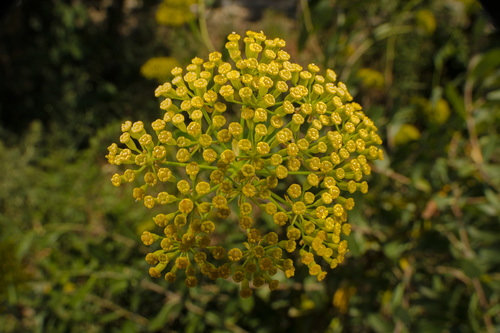
Foeniculum vulgare is a tall aromatic herbaceous perennial reaching 36-72 inches (90-180 cm) tall and 18-36 inches (45-90 cm) wide, with erect smooth blue-green hollow stems branching in the upper half. All parts release a strong anise (licorice) scent when crushed. Leaves are very finely dissected into thread-like (filiform) segments 0.5-1.5 inches (1-4 cm) long, bright green to blue-green, alternate, with inflated sheathing bases. Compound umbels 3-6 inches (8-15 cm) across carry small yellow flowers from June through September; the umbels lack both an involucre (bracts below the umbel) and an involucel (bracts below the umbellets). Fruit is a ribbed aromatic mericarp 0.15-0.2 inch (4-5 mm) long, and a single plant produces 5,000-50,000 seeds. The taproot reaches 12-24 inches (30-60 cm) below soil. Hardy in USDA zones 4-10 (-30°F / -34°C). Cultivated forms are grown commercially for the bulbous leaf base (Florence fennel, var. azoricum), aromatic seeds (spice fennel), and foliage (herb fennel). Wild fennel has naturalized across western North America, particularly along the Pacific coast from British Columbia to California and in the southeastern United States, where it forms dense monoculture stands along roadsides, coastal bluffs, and disturbed ground; the species is listed as a noxious weed in several western states. The anise swallowtail butterfly (Papilio zelicaon) uses fennel as a larval host plant.
Native Range
Foeniculum vulgare is native to the Mediterranean region and southern Europe, where it grows in dry grasslands, rocky coastal slopes, and waste ground from sea level to approximately 3,500 feet (1,100 m). The species is widely cultivated worldwide as an herb, spice, and vegetable and has naturalized across western North America, particularly along the Pacific coast from British Columbia to California, and in the southeastern United States.Suggested Uses
Cultivated forms are grown as an herb (foliage), a spice (seeds), and a vegetable (bulbous leaf base in Florence fennel / var. azoricum), planted in culinary herb gardens, vegetable beds, and ornamental borders at 12 inch (30 cm) spacing in USDA zones 4-10. The anise swallowtail butterfly (Papilio zelicaon) uses fennel as a larval host plant, so garden fennel supports swallowtail breeding in regions where the butterfly occurs. Bronze fennel (F. vulgare 'Purpureum') has dark bronze-purple foliage and is grown ornamentally in perennial borders. Classification as a noxious weed in several western U.S. states limits use near natural areas in those states, where self-seeding into open habitat is documented. Not grown in deep shade or consistently wet soils, where flowering is reduced and the taproot rots.How to Identify
Appearance
Size & Dimensions
Height3' - 6'
Width/Spread1'6" - 3'
Bloom Information
Compound umbels 3-6 inches (8-15 cm) across of small yellow flowers open from June through September, with individual umbels remaining in color for 7-10 days and sequential opening from the terminal head downward over 4-6 weeks. In the Pacific Northwest, peak bloom runs through July and August with seeds maturing by September-October. Bees, flies, and parasitic wasps work the flowers during bloom.
Detailed Descriptions
Flower Description
Yellow; small flowers in compound umbels 3-6 inches (8-15 cm) across, without involucral bracts below the umbel or involucel bracts below the umbellets; June through SeptemberFoliage Description
Bright green to blue-green; very finely dissected into thread-like (filiform) segments 0.5-1.5 inches (1-4 cm) long on inflated sheathing bases; all parts release a strong anise (licorice) scent when crushedGrowing Conditions
Sun Requirements
Requires 6-12 hours of direct sunlight daily
• Full Sun: 6+ hours of direct sunlight
• Partial Shade: 3-6 hours of direct sunlight
• Full Shade: Less than 3 hours of direct sunlight
Care & Maintenance
Care Guide
Cultivated fennel is grown in full sun in average to lean, well-drained soil with a pH of 5.5-8.0, including loam, clay, sand, and silt. Hardy in USDA zones 4-10 (-30°F / -34°C). Direct-sown seed germinates in 7-14 days at soil temperatures above 60°F (16°C); transplants establish poorly because of the taproot. Days to maturity for culinary use are 80-115 from direct sowing, depending on cultivar and end product (bulb versus seed). The species is listed as a noxious weed in several western U.S. states; in regions where naturalization into roadside and coastal bluff habitat is a documented concern, spent flower heads are cut before seeds mature to reduce self-seeding. In garden settings, deadheading after bloom and before seeds ripen prevents escape of cultivated plants into surrounding ground. Plants are difficult to dig cleanly because of the deep fleshy taproot; cutting at ground level triggers resprouting from the root crown and requires repeated cutting across 2-3 years for full suppression.Pruning
In culinary gardens, foliage is harvested continuously through the growing season and spent flower heads are cut before seeds mature to prevent self-seeding into adjacent ground. For seed harvest, umbels are cut when seeds turn brown but before they shatter, typically September through October. Where the species has naturalized, plants are cut at ground level before seed set; repeated cutting 3-4 times per growing season for 2-3 years depletes root reserves of the resprouting root crown.Toxicity
Non-toxicPlanting Guide
Planting Methods & Timing
Planting Method
direct sow
Days to Maturity
80–115 days
Plant Spacing
12 inches