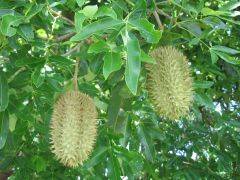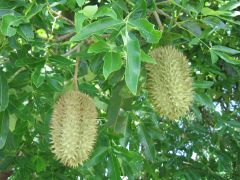
© Peter Greenwell at the English-language Wikipedia, some rights reserved (CC-BY-SA) · Wikimedia Commons
Flindersia, Genus, spp., Multiple species,
- Genus
- Multiple species
Crow's ash
Australia, New Guinea, New Caledonia, and the Moluccas
Overview
Flindersia is a genus of about 17 species of evergreen to semi-deciduous trees in the citrus family (Rutaceae), native to rainforests and drier forests of Australia, New Guinea, New Caledonia, and the Moluccas. Most are medium to large timber trees reaching 50-130 feet (15-40 m) tall, with straight trunks and dense, rounded to spreading crowns. The leaves are usually pinnately compound with glossy leaflets that are dotted with oil glands and aromatic when crushed, a trait shared across the citrus family. Small white to cream flowers are borne in branched terminal panicles in spring and summer. The fruit is a woody capsule covered in short prickles or warts that splits open into five boat-shaped valves to release flattened, winged seeds. Several species, including F. australis (crow's ash) and F. brayleyana (Queensland maple), yield close-grained cabinet and flooring timber and are grown in plantations and as street and park trees. The genus is frost-sensitive when young, and most species need a warm, frost-free climate and ample space to develop, which limits their use to large landscapes.
Native Range
Flindersia is native to eastern and northern Australia, with its center of diversity in Queensland, and extends to New Guinea, New Caledonia, and the Moluccas. It is not native to North America.Suggested Uses
Flindersia species are grown as shade, street, and park trees in subtropical and tropical regions, and in plantations for their close-grained timber. The aromatic foliage and prickled capsules add interest in large gardens and arboreta. Their eventual size suits parks, rural properties, and other open settings rather than small yards.How to Identify
Appearance
Size & Dimensions
Height50' - 130'
Width/Spread20' - 50'
Bloom Information
Flowering occurs mainly in spring and early summer, from about September to December in the Southern Hemisphere range. The small white to cream flowers are clustered in terminal panicles and attract bees and other insects. Woody prickled capsules develop over the following months and persist on the tree before splitting.
Detailed Descriptions
Flower Description
white to creamFoliage Description
glossy greenGrowing Conditions
Sun Requirements
Requires 5-10 hours of direct sunlight daily
• Full Sun: 6+ hours of direct sunlight
• Partial Shade: 3-6 hours of direct sunlight
• Full Shade: Less than 3 hours of direct sunlight