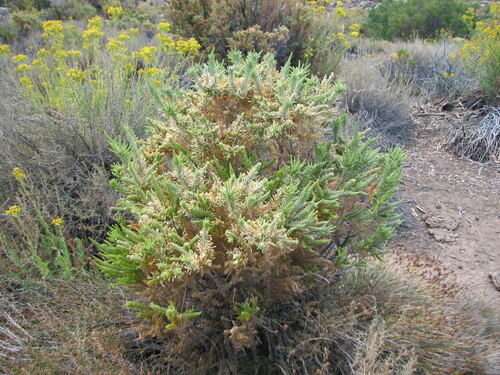
Fabiana, Genus, imbricata, Species,
- Genus & species
pichi
Chile and Argentina (Patagonia; dry rocky coastal scrub to Andean slopes at 0-8,000 feet)
Overview
Fabiana imbricata is an upright to arching densely branched evergreen shrub in the nightshade family (Solanaceae) reaching 5–8 feet (1.5–2.4 m) tall with a spread of 4–6 feet (1.2–1.8 m). This South American species carries a heather-like or conifer-like appearance that separates it visually from most shrubs in cultivation — the tiny scale-like overlapping (imbricate) leaves 0.1 inch (2–3 mm) long are densely pressed against the slender plume-like branches, which produces a soft-textured mass that resembles a large heather or a small-needled conifer. Flowers are small tubular white 0.5 inch (1 cm) long, carried in profuse clusters along the upper branches in June–July, and the flowering covers the upper portion of the shrub in white bloom. The overall effect is a small-leaved feathery evergreen mass that produces heavy white flowering in early summer. Growth rate is moderate. The species belongs to Solanaceae (nightshade family) rather than the heather-containing Ericaceae family, which makes the heather-like resemblance an example of convergent evolution in plant form rather than taxonomic relationship. Hardy to zone 8.
Native Range
Fabiana imbricata is native to Chile and adjacent Argentina (Patagonia), where it occurs in dry open rocky habitats ranging from coastal scrub vegetation to Andean slopes at 0–8,000 feet (0–2,400 m).Suggested Uses
Grown as a specimen or within mixed borders at 4–5 foot (1.2–1.5 m) spacing. The small-leaved heather-like evergreen foliage carries year-round structural interest that few other shrubs of comparable mature size can match at the same scale. The June–July white bloom covers the shrub in flowering that reads at distance across the garden. The species functions in Mediterranean-style and coastal garden compositions, and the plant stands as an uncommon Solanaceae-family shrub that resembles a giant heather visually while carrying entirely different taxonomic heritage. Pairing with other small-leaved companions and Mediterranean shrubs builds a climate-matched composition on shared drainage and light preferences. Wet soils, cold zones below 8, exposed inland sites with cold drying winds, and shaded positions are not suitable given the cultural preferences.How to Identify
Appearance
Size & Dimensions
Height5' - 8'
Width/Spread4' - 6'
Bloom Information
Small tubular white flowers 0.5 inch (1 cm) long open in profuse clusters along the upper branches in June–July. The flowering covers the upper portion of the shrub in dense white bloom that reads at distance and carries pollinator traffic. Bloom duration is 3–4 weeks.
Detailed Descriptions
Flower Description
White small tubular flowers 0.5 inch long in profuse clusters along branchesFoliage Description
Tiny scale-like overlapping (imbricate); bright green to mid-green; heather-like texture on plume branchesGrowing Conditions
Sun Requirements
Requires 6-10 hours of direct sunlight daily
• Full Sun: 6+ hours of direct sunlight
• Partial Shade: 3-6 hours of direct sunlight
• Full Shade: Less than 3 hours of direct sunlight
Care & Maintenance
Care Guide
Grows in full sun in well-drained lean to moderately fertile acidic to neutral soil at pH 5.5–7.0, tolerating sand and loam. Drought-tolerant once established. Hardy to zone 8. Sharp drainage through the dormant season is essential — wet winter soils produce root rot that can kill the plant before the growing season resumes. Sheltering the plant from cold drying winds preserves the heather-like foliage from desiccation damage in marginal zone 8 positions. In marginal cold zones, siting against a warm south- or west-facing wall adds several degrees of winter protection that improves survival rates through cold snaps. No serious pest or disease problems.Pruning
Light pruning after flowering (July) maintains shape and controls overall size. Moderate pruning is tolerated, but cutting into bare old wood should be avoided because regeneration from old wood runs slow and unreliable compared with most evergreen shrubs. The natural arching form is the intended habit, and heavy reshaping that breaks the arching silhouette works against the species structural character.Pruning Schedule
Prune: July
summer