Eurya, Genus, japonica, Species,
- Genus & species
Japanese eurya
Japan, Korea, Taiwan, and southern China
Overview
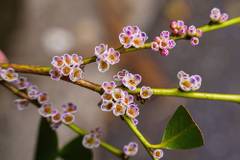
Eurya japonica is an evergreen shrub or small tree in the family Pentaphylacaceae, native to Japan, Korea, Taiwan, and southern China. Plants reach 6–15 feet (1.8–4.5 m) tall and 5–10 feet (1.5–3 m) wide, with a dense, upright to rounded habit and slender, ascending branches. Leaves are alternate, elliptic to obovate, 1–3 inches (2.5–7.5 cm) long, leathery, and glossy dark green above, with finely serrated margins and short petioles. Flowers are small, 0.2 inch (5 mm) across, greenish white to cream, and borne in clusters of 1–3 in the leaf axils in March and April. Plants are dioecious, with male and female flowers on separate plants, and only female plants bear fruit. Fruit is a round black berry 0.15–0.25 inch (4–6 mm) across that ripens in autumn. Plants are hardy in USDA zones 7–9. Growth is slow, and leaves scorch in hot, dry sun and in desiccating winter wind. Cut branches are used in Shinto ritual offerings in parts of Japan.
Native Range
Native to Japan, Korea, Taiwan, and southern China, where it grows in the understory of evergreen broadleaf forests and in coastal thickets. Grown in temperate and subtropical gardens outside its native range.Suggested Uses
Used as an evergreen hedge, screen, and understory shrub in shaded gardens, spaced 3–5 feet (0.9–1.5 m) apart. Cut branches are used in Shinto ritual offerings in Japan. Slow growth and limited cold hardiness restrict use to zones 7–9.How to Identify
Appearance
Size & Dimensions
Height6' - 15'
Width/Spread5' - 10'
Bloom Information
Flowers open in March and April, and individual flowers last about one week. Plants are dioecious, with male and female flowers on separate plants. Flowers are small and borne under the leaves in clusters of 1–3. Fruit forms on female plants only and ripens by autumn.
Detailed Descriptions
Flower Description
Greenish white to creamFoliage Description
Glossy dark greenGrowing Conditions
Sun Requirements
Requires 2-5 hours of direct sunlight daily
• Full Sun: 6+ hours of direct sunlight
• Partial Shade: 3-6 hours of direct sunlight
• Full Shade: Less than 3 hours of direct sunlight
Care & Maintenance
Care Guide
Growth is steadiest in part shade to full shade in moist, well-drained, acidic to neutral soil of pH 5.5–7.0 that is high in organic matter. Leaves scorch in hot afternoon sun, and plants in full sun require regular watering. Water is applied at 1 inch (2.5 cm) per week during the first two growing seasons and during dry periods afterward. Cold hardiness is USDA zones 7–9, and winter wind causes leaf browning in colder areas. A 2–3 inch (5–8 cm) layer of organic mulch conserves soil moisture.Pruning
Little pruning is required. Shaping and size control are done in late spring after flowering, and plants tolerate shearing to 3–4 feet (0.9–1.2 m) for hedge use. Dead and crossing stems are removed at any time. Plants regrow from old wood after hard pruning.Pruning Schedule
Prune: May–June
late spring