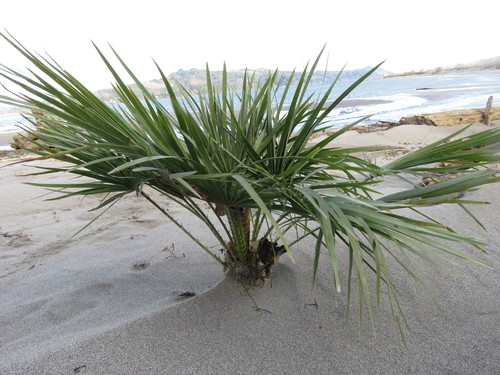
Chamaerops, Genus, humilis, Species,
- Genus & species
European fan palm
Western Mediterranean basin — southern Spain, Portugal, southern Italy, Sicily, Malta, North Africa from Morocco to Libya, and the Balearic and Tyrrhenian islands; the only palm species native to continental Europe
Overview
Chamaerops humilis is the European fan palm — the only palm species native to continental Europe — grown as a clumping multi-stemmed shrub-like palm in Mediterranean and warm-temperate gardens, reaching 6–15 ft (1.8–4.5 m) tall and 6–12 ft (1.8–3.6 m) wide. The species range spans the western Mediterranean basin: southern Spain, Portugal, southern Italy, Sicily, Malta, North Africa from Morocco to Libya, and the Balearic and Tyrrhenian islands, where it grows on coastal cliffs, rocky slopes, and dry scrubland at low to mid elevations. The species epithet 'humilis' translates as 'low' or 'humble' and refers to the relatively small stature compared with most palms. Each plant produces 5–15 thick fibrous trunks 4–8 inches (10–20 cm) thick from a basal clump, with each trunk carrying a crown of stiff fan-shaped (palmate) fronds 18–36 inches (45–90 cm) across composed of 15–30 narrow leaflets radiating from a central point. Foliage color ranges from medium green in the species form to powder-blue in the variety C. humilis var. cerifera (the Atlas Mountains form). The plant is dioecious — separate male and female plants — and produces small yellow flower clusters in spring on mature specimens, followed by small red-brown to yellow-brown drupes 0.4–0.6 inch (10–15 mm) on female plants. Cold tolerance reaches USDA zone 8 with foliage damage at 15°F (−9°C) and stem damage below 10°F (−12°C); the species is among the cold-hardiest palms grown commercially, after Trachycarpus fortunei and Rhapidophyllum hystrix. Drought-tolerant, salt-tolerant, and deer-resistant once established. Non-toxic to dogs and cats.
Native Range
Chamaerops humilis is the only palm species native to continental Europe, with a range across the western Mediterranean basin: southern Spain, Portugal, southern Italy, Sicily, Malta, North Africa from Morocco to Libya, and the Balearic and Tyrrhenian islands. It grows on coastal cliffs, rocky slopes, and dry scrubland at low to mid elevations.Suggested Uses
Used as a Mediterranean specimen palm in warm-temperate gardens, on coastal sites with salt exposure, in xeric and rock gardens, and in containers of 10–25 gallons (38–95 liters) for patios and indoor overwintering in colder zones. The clumping multi-trunk habit creates a sculptural mass that single-trunk palms cannot. Combines with other Mediterranean plants such as Lavandula, Rosmarinus, Cistus, and Olea europaea for a regional planting style. Suitable for households with cats and dogs that browse foliage due to non-toxic status.How to Identify
Appearance
Size & Dimensions
Height6' - 15'
Width/Spread6' - 12'
Colors
Bloom Information
Mature dioecious plants flower in spring, producing small yellow flower clusters at the base of the fronds; female plants follow with small red-brown to yellow-brown drupes 0.4–0.6 inch (10–15 mm) that ripen in late summer. Bloom is incidental to the year-round palm-shape display.
Detailed Descriptions
Flower Description
Small yellow flower clusters in spring on mature dioecious plants; female plants follow with red-brown to yellow-brown drupesFoliage Description
Medium green to powder-blue stiff fan-shaped (palmate) fronds 18-36 inches (45-90 cm) across composed of 15-30 narrow leaflets radiating from a central pointGrowing Conditions
Sun Requirements
Requires 6-12 hours of direct sunlight daily
• Full Sun: 6+ hours of direct sunlight
• Partial Shade: 3-6 hours of direct sunlight
• Full Shade: Less than 3 hours of direct sunlight
Care & Maintenance
Care Guide
Place in full sun for 6 or more hours daily; the plant tolerates partial shade in hot tropical climates but the foliage opens looser there. Soil tolerance is broad — the species grows in sandy, loamy, rocky, calcareous, and saline soils at pH 6.0–8.5, with sharp drainage required. Water during the first 2 years of establishment, then irrigate only during prolonged drought; mature plants are deeply drought-tolerant. The species is hardy through USDA zone 8 with brief snow tolerance and recovers from foliage damage at 15°F (−9°C); plants in zones 7 and colder require a sheltered microclimate or container culture brought indoors for winter. Skip fertilizer; rich soils produce loose floppy growth that loses the dense fan-shaped silhouette. The petioles carry sharp spines along the edges that can cut skin during pruning, so leather gauntlets are appropriate when handling old fronds.Pruning
Cut spent yellow or brown fronds at the base of the petiole with clean pruners; the petiole spines along the edges can cut skin, so leather gauntlets are appropriate. Pruning is rare on younger plants and increases on mature multi-trunk specimens where the inner fronds need clearing every 2–3 years. The trunks themselves are not pruned and self-clean as old fronds drop.Container Growing
Suitable for container growing
Minimum container size: 10 gallons