Eriocoma, Genus, hymenoides, Species,
- Genus & species
sand ricegrass
Overview
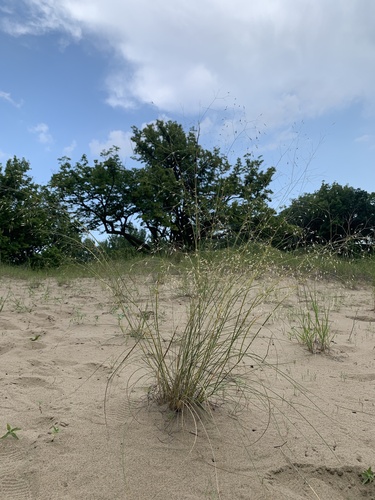
Eriocoma hymenoides is a cool-season perennial bunchgrass in the grass family (Poaceae), forming dense, rounded tufts 12-24 inches (30-60 cm) tall of slender, threadlike leaves that roll inward and stay green into early summer. From late spring it produces an open, widely spreading panicle held above the foliage, the much-branched stalks ending in small, plump seeds, each on a delicate, wiry stem that lets the whole seed head shimmer in wind. The single seeds are relatively large for a grass, dark, and shed readily. Roots reach deep into sandy soil, letting the plant survive on very little water in arid western rangeland. The large seeds were ground into meal as a traditional food. Foliage cures to straw color in summer drought and greens again with cooler, wetter weather. A limitation in cultivation is that it is short-lived and slow to establish in rich or heavy soils.
Native Range
Eriocoma hymenoides is native to western North America, ranging across the dry interior from British Columbia and the Great Plains west to California and south into northern Mexico. It grows on sandy and gravelly soils of deserts, sagebrush steppe, dunes, and open rangeland.Suggested Uses
This grass is used in dryland restoration, erosion control on sandy soils, xeriscapes, and native plant gardens. Its seeds feed birds, small mammals, and livestock, and the airy seed heads add movement to plantings. It also serves as forage on arid rangeland.How to Identify
Appearance
Size & Dimensions
Height1' - 2'
Width/Spread1' - 1'6"
Bloom Information
Detailed Descriptions
Flower Description
tan to strawFoliage Description
green to strawGrowing Conditions
Sun Requirements
Requires 6-12 hours of direct sunlight daily
• Full Sun: 6+ hours of direct sunlight
• Partial Shade: 3-6 hours of direct sunlight
• Full Shade: Less than 3 hours of direct sunlight
Care & Maintenance
Care Guide
Eriocoma hymenoides grows in full sun in sandy, gravelly, or other very well-drained soils and tolerates intense drought and heat once established. It is adapted to low rainfall and rots in rich, wet, or heavy clay soils. Seed can be slow and erratic to germinate, often needing cool, moist stratification, after which seedlings establish a deep root system. The plant needs no fertilizer and little or no irrigation in dry climates. It is grown for erosion control, rangeland restoration, and dry native gardens. Foliage goes summer-dormant in drought and revives with cooler, moister conditions.Pruning
Pruning is limited to cutting back the clump in late winter to remove old growth before new shoots appear. Spent flower stalks can be sheared off after seed drop. No other trimming is needed.Container Growing
Suitable for container growing
Minimum container size: 2 gallons