Eremothera, Genus, boothii, Species,
- Genus & species
Booth's evening primrose
Overview
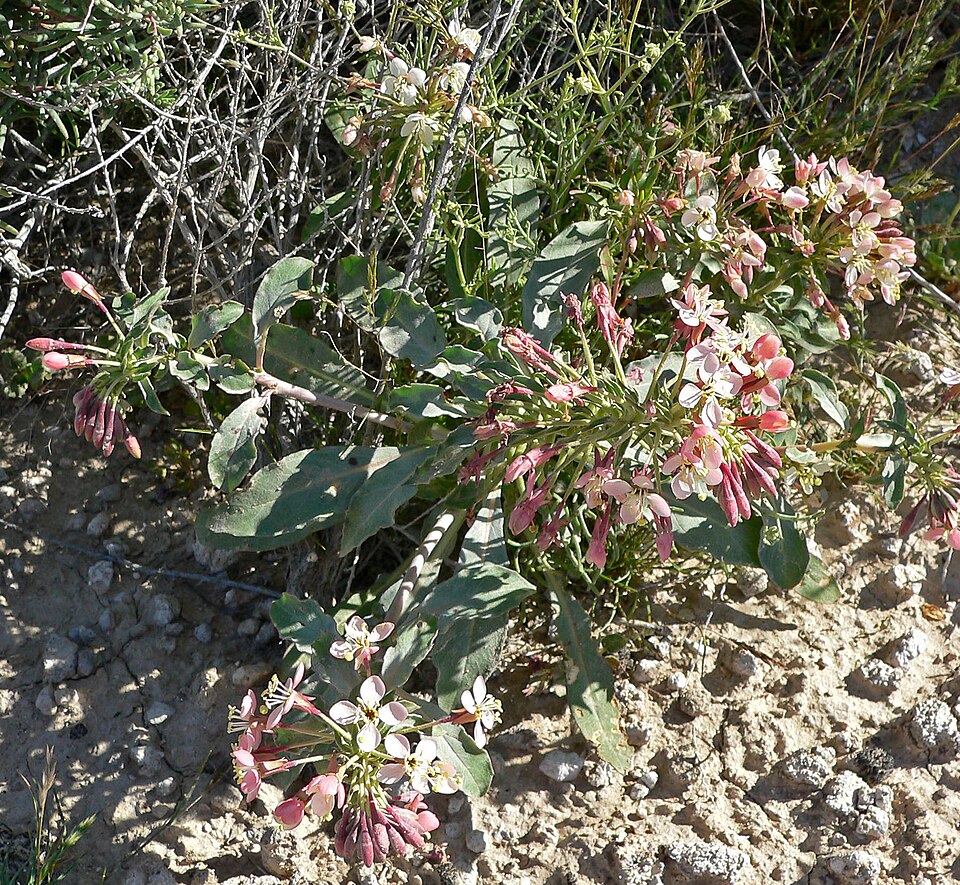
Eremothera boothii is an annual of arid western North America, growing 4-16 inches (10-40 cm) tall with slender, often reddish stems whose outer skin peels away in thin strips. The narrow lance-shaped leaves are 0.5-3 inches (1.5-8 cm) long, mostly in a basal cluster and along the lower stem, with wavy or toothed margins. The flowers are small, four-petaled, and white, 0.2-0.4 inch (5-10 mm) wide, opening in the evening and fading to pink or red by the next day. The buds and developing seed capsules nod downward before straightening as the fruit matures. Eremothera boothii grows in sandy and gravelly desert flats, washes, and slopes, often on disturbed ground, across the Great Basin and southwestern deserts. It germinates with autumn or winter rain, flowers in spring, and completes its cycle before summer drought. The plant is moth-pollinated, matching its evening flower opening, and sets numerous tiny seeds. It is short-lived and grows only where seasonal moisture allows.
Native Range
Eremothera boothii is native to western North America, across the Great Basin and the Mojave and Sonoran deserts from Oregon and Idaho south to California, Arizona, and northern Mexico. It grows in sandy desert flats, washes, and slopes.Suggested Uses
Eremothera boothii is used in desert and dry-climate native plantings, rock gardens, and restoration of disturbed arid ground, spaced 6-10 inches (15-25 cm) apart. Its evening flowers support night-flying moths. The plant suits low-water gardens where summer irrigation is absent.How to Identify
Appearance
Size & Dimensions
Height4" - 1'4"
Width/Spread6" - 1'
Bloom Information
Flowers open in spring, roughly March to June depending on elevation and rainfall, each bloom opening in the evening and closing the next day. White petals turn pink to red as they age. The flowering window is short and tied to winter and spring moisture.
Detailed Descriptions
Flower Description
white aging to pink or redFoliage Description
greenGrowing Conditions
Sun Requirements
Requires 6-12 hours of direct sunlight daily
• Full Sun: 6+ hours of direct sunlight
• Partial Shade: 3-6 hours of direct sunlight
• Full Shade: Less than 3 hours of direct sunlight
Water & Climate
Water Needs
Drought Tolerance
Drought tolerant when established
Care & Maintenance
Care Guide
Eremothera boothii grows in full sun and sharply drained sandy or gravelly soil, including poor and disturbed desert ground. It depends on autumn and winter rainfall to germinate and complete its cycle before summer heat. Water is rarely needed in its native range, and excess moisture or rich soil does not suit it. The plant is grown from seed sown in autumn where winters are mild. It self-sows where bare, open soil remains available. No fertilizer or routine care is needed for this desert annual.Pruning
No pruning is needed. Plants are pulled once seed has set and the foliage dries. Seed heads are left in place to allow self-seeding for the following season.Toxicity
Non-toxicPlanting Guide
Planting Methods & Timing
Planting Method
direct sow
Direct Sow Timing
Autumn in mild-winter desert climates
Days to Maturity
60–120 days
Plant Spacing
8 inches
Companion Planting
Good Companions