Overview
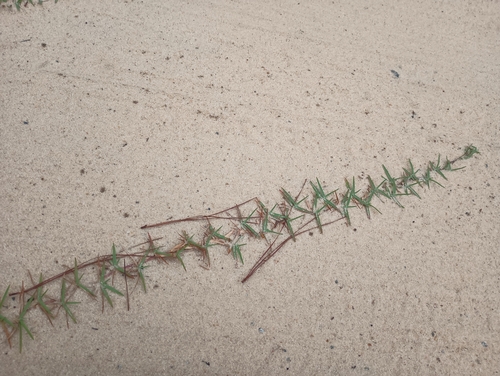
Eremochloa ophiuroides is a warm-season perennial grass in the Poaceae that spreads by above-ground stolons to form a dense sod, standing 3-6 inches (8-15 cm) high under mowing and reaching 10 inches (25 cm) unmown. Leaf blades are flat, 0.1-0.2 inch (3-5 mm) wide and 1-3 inches (2.5-8 cm) long, light to medium green, ending in a blunt rounded tip. Leaf sheaths are flattened and overlap along the stolon in a shingled arrangement that gives the creeping stem a segmented outline. Stolons root at nodes spaced 1-2 inches (2.5-5 cm) apart and extend 12-24 inches (30-60 cm) per season. The inflorescence is a single spike-like raceme 1.5-3 inches (4-8 cm) long, carried 3-6 inches (8-15 cm) above the leaf canopy from June through August. Foliage colour sits lighter green than bermudagrass or zoysiagrass at the same fertility. A stand takes 2-3 years to close from seed and recovers from wear over 6-10 weeks. Leaf tissue browns after frost and regreens in spring. Iron chlorosis develops above pH 7.0, and stands thin over 3-5 years where nitrogen passes 2 pounds per 1,000 square feet (100 g per square metre) per year.
Native Range
Native to southeastern China and adjacent parts of Southeast Asia, where it grows in open grassland, forest margins, and disturbed ground at low to moderate elevations. Seed was collected in China and introduced to the United States in 1916 by the plant explorer Frank N. Meyer. It is now naturalised and widely planted across the southeastern United States from eastern Texas to the Carolinas.Suggested Uses
Used for home lawns, parks, and roadsides across the southeastern United States in zones 7-10, on acid sandy soils where mowing frequency and fertiliser inputs are held low. Wear tolerance is limited and recovery from traffic damage runs 6-10 weeks, so stands are placed apart from sports pitches and heavily used play areas. It grows under light shade receiving 4-6 hours of direct sun and thins below that.How to Identify
Appearance
Size & Dimensions
Height3" - 6"
Width/Spread1' - 2'
Bloom Information
Seed heads rise from June through August in the southeastern United States, with the peak in July. Each raceme sheds pollen over 5-10 days, and a stand carries seed heads across 6-8 weeks. Mowing at 1-2 inches (2.5-5 cm) every 10-14 days removes most seed heads before they mature. Stands mown at 3 inches (7.5 cm) or left uncut set viable seed by late August.
Detailed Descriptions
Flower Description
green to straw-coloured racemeFoliage Description
light to medium greenGrowing Conditions
Sun Requirements
Requires 4-12 hours of direct sunlight daily
• Full Sun: 6+ hours of direct sunlight
• Partial Shade: 3-6 hours of direct sunlight
• Full Shade: Less than 3 hours of direct sunlight
Care & Maintenance
Care Guide
Stands establish from seed at 0.25-0.5 pound per 1,000 square feet (12-25 g per square metre), from sprigs, or from sod, with seeded stands closing over 2-3 growing seasons. Nitrogen is held to 1-2 pounds per 1,000 square feet (50-100 g per square metre) per year across one or two applications, since higher rates build thatch and precede stand decline in years 3-5. Soil pH between 4.5 and 6.0 holds foliage green, and iron chlorosis appears within one season above pH 7.0, treated with chelated iron. Mowing at 1-2 inches (2.5-5 cm) every 10-14 days through the growing season holds the canopy dense. Ground pearls, scale insects in the genus Margarodes, feed on roots in sandy soils with no registered chemical treatment available, and affected patches thin and die over 1-2 seasons. Large patch, caused by Rhizoctonia solani, spreads in spring and fall when soil temperatures sit between 60 and 70 degrees F (16-21 degrees C).Pruning
Mowing runs from April through October at 1-2 inches (2.5-5 cm), every 10-14 days during active growth. Scalping below 1 inch (2.5 cm) exposes stolons and takes 4-6 weeks to recover. Thatch above 0.5 inch (13 mm) is removed by vertical mowing in late spring after full green-up rather than in fall. Edges are cut back where stolons cross into beds and paving, since stolons extend 12-24 inches (30-60 cm) per season.Pruning Schedule
Prune: April–October
late springsummerfall