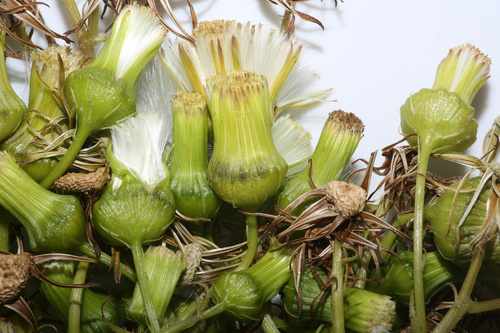
Erechtites, Genus, hieraciifolius, Species,
- Genus & species
American burnweed
SunFull Sun – Part Shade
WaterMedium
Overview
Erechtites hieraciifolius is a coarse annual in the aster family, growing 1.5 to 8 feet (0.5-2.4 m) tall on a hollow, grooved, often single stem. The leaves are alternate, lance-shaped to oblong, 2-8 inches (5-20 cm) long, with irregularly toothed or lobed margins, stalkless and clasping toward the top of the stem. Flower heads are cylindrical, 0.5-0.7 inch (12-17 mm) long, lacking ray florets and swollen at the base, with whitish to greenish disc florets that barely open past the green bracts. Heads nod in branched clusters and give way to dense tufts of white pappus that carry the seed on the wind. The species germinates rapidly on disturbed and recently burned ground, often forming temporary stands that fade as perennial vegetation returns. It is shallow-rooted, weak-stemmed, and short-lived, dying after a single season. The foliage contains pyrrolizidine alkaloids that are toxic to grazing animals and to humans if eaten in quantity. On cultivated ground it colonizes bare soil quickly and is commonly treated as a weed.
Native Range
Native to eastern and central North America, from Newfoundland and Ontario south to Florida and Texas, and naturalized in parts of Asia and the Pacific. It colonizes clearings, burned areas, moist woodland edges, and disturbed ground.Suggested Uses
Occurs mainly as a pioneer species in the recovery of burned or cleared sites rather than as a planted ornamental. It gives quick ground cover and seed for birds on disturbed land. In gardens it is usually managed as a self-seeding weed rather than a cultivated subject.How to Identify
Appearance
Size & Dimensions
Height1'6" - 8'
Width/Spread1' - 2'
Bloom Information
Detailed Descriptions
Foliage Description
GreenGrowing Conditions
Sun Requirements
Requires 4-10 hours of direct sunlight daily
• Full Sun: 6+ hours of direct sunlight
• Partial Shade: 3-6 hours of direct sunlight
• Full Shade: Less than 3 hours of direct sunlight
Water & Climate
Water Needs
Care & Maintenance
Care Guide
Grows in full sun to part shade on moist, fertile, disturbed soil. It tolerates a range of soil types and pH but favors freshly cleared or burned ground rich in organic matter. Seed needs bare soil and light to germinate, so established turf or mulch suppresses it. No watering or feeding is needed once seedlings emerge. Plants complete their cycle in one season and do not persist. Self-sown seed can produce dense stands the following year where soil stays open.Pruning
No pruning is needed for this annual. Plants can be cut or pulled before the seed heads mature to limit spread, as they lift easily from loose soil. Cut stems do not regrow.Toxicity Warning
Toxic to pets and humansPlanting Guide
Planting Methods & Timing
Planting Method
direct sow