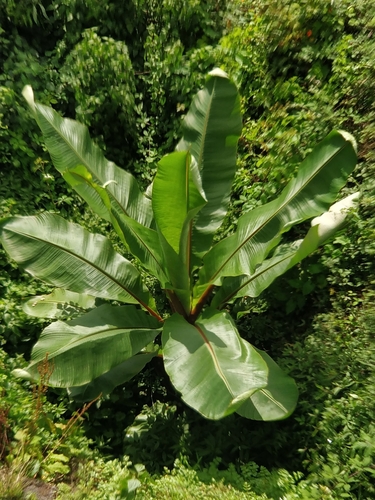
Ensete, Genus, ventricosum, Species,
- Genus & species
Ethiopian banana
SunFull Sun – Part Shade
Waterhigh
Overview
Ensete ventricosum is the Ethiopian banana (false banana), growing 72–240 inches (180–600 cm) tall in a single pseudostem formed by tightly overlapping leaf sheaths. Large paddle-shaped leaves 48–120 inches (120–300 cm) long and 24–36 inches (60–90 cm) wide with a red-burgundy midrib — the leaves tear along the lateral veins in wind, which is a structural characteristic of the Musaceae family (banana family), not a sign of damage. Not a true banana — in the genus Ensete, not Musa. The fruit is inedible (hard, seedy, and dry), but the starchy pseudostem and corm are a staple food for approximately 20 million people in southern Ethiopia, where the plant is cultivated as a crop called 'kocho.' Monocarpic: flowers once after 5–8 years, then the entire plant dies. Unlike true bananas (Musa), Ensete does not produce offsets (pups) — once the plant flowers and dies, it is gone unless seeds were collected. Propagated by seed only. Frost-tender: foliage is killed by frost; the corm may survive brief dips to 25°F (−4°C) with heavy mulching. Heavy water and rich soil for rapid growth. Full sun. Wind tears the leaves. Non-toxic. Growth rate is fast — can add 36–72 inches (90–180 cm) per year in warm conditions. Containers of 15–25 gallons (60–95 liters) in cold zones with indoor winter storage.
Native Range
Native to Ethiopia and the highlands of East Africa. Cultivated as a food crop (kocho) in southern Ethiopia for the starchy pseudostem and corm.Suggested Uses
Grown as a tropical foliage specimen in containers of 15–25 gallons (60–95 liters) with indoor winter storage in cold zones. In the ground in frost-free zones. Full sun. Wind-sheltered positions reduce leaf tearing. Non-toxic. Monocarpic.How to Identify
Appearance
Size & Dimensions
Height6' - 20'
Width/Spread6' - 12'
Bloom Information
A large terminal inflorescence produced after 5–8 years of vegetative growth. Monocarpic — the plant dies after flowering. Does not produce offsets. Rarely flowers in temperate cultivation due to insufficient growing-season length.
Detailed Descriptions
Flower Description
White to cream, in a large terminal inflorescenceFoliage Description
Green with red-burgundy midribGrowing Conditions
Sun Requirements
Requires 6-10 hours of direct sunlight daily
• Full Sun: 6+ hours of direct sunlight
• Partial Shade: 3-6 hours of direct sunlight
• Full Shade: Less than 3 hours of direct sunlight
Care & Maintenance
Care Guide
Full sun. Heavy water and rich soil for rapid growth. Frost-tender — foliage killed by frost; corm may survive to 25°F (−4°C) with heavy mulch. Wind tears the leaves. Monocarpic (flowers once, dies). Does not produce offsets — propagated by seed only. Non-toxic. Fast-growing.Pruning
Remove browned or wind-torn leaves at the pseudostem. No other pruning needed. The pseudostem is formed by overlapping leaf sheaths, not true wood.Container Growing
Suitable for container growing
Minimum container size: 15 gallons