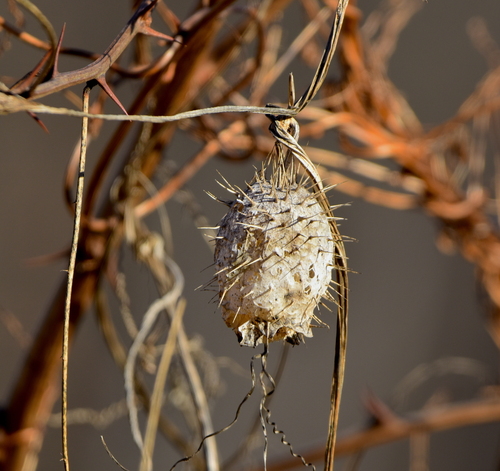
Echinocystis, Genus, lobata, Species,
- Genus & species
prickly cucumber
SunFull Sun – Part Shade
WaterMedium
Overview
Echinocystis lobata is a fast-growing annual climbing vine native to North America, reaching 15-25 feet (4.5-7.5 m) in a single season by means of branched, coiling tendrils. The thin, light-green leaves are palmately five-lobed with pointed tips, 3-5 inches (7.5-12.5 cm) wide, resembling maple or cucumber leaves. In mid to late summer the vine produces upright, branched clusters of small, star-shaped greenish-white flowers, each with six narrow petals, while separate female flowers sit at the base of the clusters. Pollinated female flowers develop into inflated, egg-shaped fruits about 2 inches (5 cm) long, covered in soft spines and filled with a network of fibers and four large flat seeds. The fruit dries, splits at the bottom, and ejects its seeds. Despite the common name, the fruit is not edible. E. lobata grows along stream banks, moist thickets, fence rows, and disturbed ground, climbing over shrubs and other vegetation. It can blanket supporting plants in a season but dies completely with the first hard frost. It reseeds freely and may return densely the following year. Growth is rapid in warm, moist conditions.
Native Range
Echinocystis lobata is native to much of North America, from Canada south through the central and eastern United States. It grows along stream banks, moist thickets, floodplains, fence rows, and disturbed ground.Suggested Uses
E. lobata is used for quick seasonal cover on fences, arbors, and trellises, and in native and wildlife plantings near water. Its summer flowers support bees and other pollinators. It is grown as a temporary screen rather than a permanent vine, since it dies each winter.How to Identify
Appearance
Size & Dimensions
Height15' - 25'
Width/Spread3' - 6'
Bloom Information
E. lobata blooms in mid to late summer, generally July to September. The upright clusters of small greenish-white flowers open over several weeks, drawing bees and other insects. Spiny inflated fruits follow and ripen in fall before the vine dies at frost.
Detailed Descriptions
Foliage Description
light greenGrowing Conditions
Sun Requirements
Requires 4-10 hours of direct sunlight daily
• Full Sun: 6+ hours of direct sunlight
• Partial Shade: 3-6 hours of direct sunlight
• Full Shade: Less than 3 hours of direct sunlight
Water & Climate
Water Needs
Care & Maintenance
Care Guide
E. lobata grows in full sun to part shade and favors moist, fertile soil near water. It tolerates a range of soils but needs steady moisture to climb vigorously. Water needs are moderate to high. As an annual, it completes its life cycle in one season and dies at the first hard frost. It needs a fence, trellis, or neighboring plants to climb. The vine self-seeds heavily, so removing fruit before seed drops limits its return.Pruning
E. lobata is an annual and needs no structural pruning. Stems can be cut back during the season to keep the vine off plants it might smother. Removing the spiny fruits before they ripen reduces self-seeding.Toxicity Warning
Toxic to pets and humansPlanting Guide
Planting Methods & Timing
Planting Method
direct sow
Direct Sow Timing
spring after last frost
Days to Maturity
90–120 days
Plant Spacing
24 inches