Overview
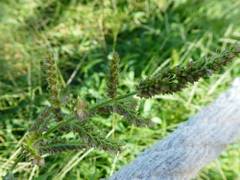
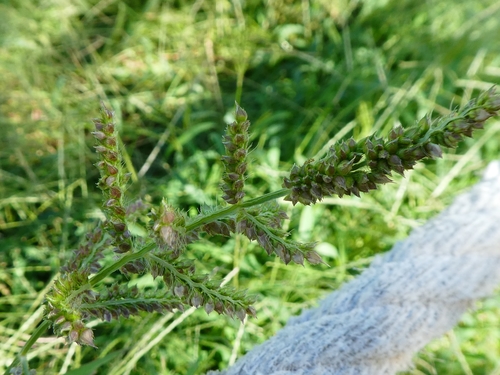
Echinochloa is a genus of about 35 annual and perennial grasses in the family Poaceae, the barnyard grasses, found across warm-temperate and tropical regions worldwide. Most are coarse, fast-growing grasses 1-5 ft (30-150 cm) tall, with stout often-branching culms, flat leaf blades 0.2-1 in (0.5-2.5 cm) wide, and a ligule that is reduced or absent. Flowering panicles are dense and bristly, 4-10 in (10-25 cm) long, the spikelets crowded along stiff branches and often bearing long awns that give a green to purplish, sometimes reddish cast. Seed is produced in large amounts and germinates readily in warm, wet ground. Several species, above all barnyard grass E. crus-galli and jungle rice E. colona, rank as major weeds of rice and row crops, while E. esculenta and E. frumentacea are grown as fast-maturing millets for grain and forage. The genus favors saturated and disturbed soils, including ditches, pond edges, and flooded fields. Plants complete their cycle quickly and die back at season end in temperate climates.
Native Range
Echinochloa is native across the warm-temperate and tropical parts of Africa, Asia, and the Americas, with the native range of widespread species such as E. crus-galli blurred by long association with agriculture. The weedy species now occur on every continent except Antarctica. Plants grow naturally in marshes, riverbanks, ditches, and seasonally flooded ground.Suggested Uses
Cultivated species such as Japanese millet E. esculenta are grown for grain, forage, and as a fast cover or wildlife food plot, and stands draw seed-eating birds and waterfowl. The weedy species have no garden use and are managed in crops and wetlands. Sown about 6-12 in (15-30 cm) apart or broadcast for forage and cover.How to Identify
Appearance
Size & Dimensions
Height1' - 5'
Width/Spread1' - 2'
Bloom Information
Echinochloa flowers from summer into autumn, generally July to October, once plants reach full height. The bristly panicles shift from green to purplish or straw-colored as the seed ripens. A single plant can mature many thousands of seeds within a few weeks of flowering.
Detailed Descriptions
Flower Description
Green to purplish or straw-coloredFoliage Description
Green, often with reddish or purplish stem basesGrowing Conditions
Sun Requirements
Requires 6-10 hours of direct sunlight daily
• Full Sun: 6+ hours of direct sunlight
• Partial Shade: 3-6 hours of direct sunlight
• Full Shade: Less than 3 hours of direct sunlight
Water & Climate
Water Needs
Care & Maintenance
Care Guide
Echinochloa grows in full sun on moist to wet, fertile soil and tolerates standing water and periodic flooding, which underlies its success in rice paddies. Plants accept clay, loam, and silt at a soil pH of about 5.0 to 7.5 and grow fastest in warm conditions above 68F (20C). The cultivated millets are sown directly after the soil warms and mature in roughly 45 to 90 days. As warm-season grasses they are killed by frost and do not persist through cold winters. Established stands set abundant seed, so spread is the main concern with the weedy species.Pruning
Routine pruning is not needed. Flowering panicles are cut before seed sets to limit self-seeding of the weedy species. Whole plants are removed or cut at season end as they die back with frost.Toxicity
Non-toxicPlanting Guide
Planting Methods & Timing
Planting Method
direct sow
Direct Sow Timing
Late spring to early summer after the soil warms
Days to Maturity
45–90 days
Plant Spacing
8 inches