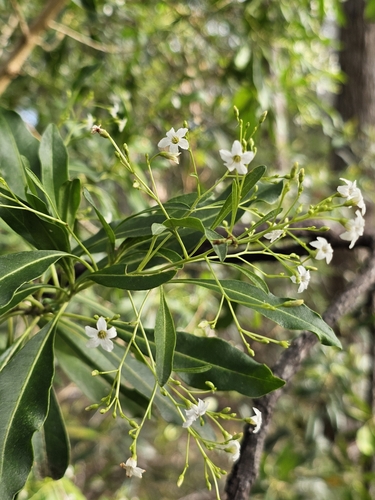
Duboisia, Genus, spp., Multiple species,
- Genus
- Multiple species
corkwood
Overview
Duboisia is a genus of three species of evergreen shrubs and small trees in the nightshade family, Solanaceae, native to Australia and New Caledonia, where they are called corkwoods for their soft, corky bark. Plants grow 2-12 m (7-40 ft) tall, with alternate, soft, often greyish leaves and clusters of small, white, bell-shaped flowers 3-6 mm (0.1-0.2 in) long. Small black berries follow the flowers. All species contain tropane alkaloids, chiefly hyoscyamine and scopolamine, which are toxic to humans and animals if ingested. D. myoporoides and D. leichhardtii are grown commercially for these alkaloids, which are extracted for medical use, while D. hopwoodii, known as pituri, was chewed by Aboriginal peoples of central Australia as a stimulant. The genus grows in open forest, scrub, and arid inland country, and many species are drought-tolerant and fast-growing. In cultivation corkwoods are grown as fast screens and shade plants in warm, frost-free climates.
Native Range
Native to eastern and inland Australia and to New Caledonia. Plants grow in open eucalypt forest, coastal scrub, and arid inland country on a range of soils.Suggested Uses
Grown as a fast screen, windbreak, and shade shrub in warm, dry gardens and on rural properties. Used in revegetation of inland sites, and grown commercially as a crop for pharmaceutical alkaloids.How to Identify
Appearance
Size & Dimensions
Height7' - 40'
Width/Spread7' - 20'
Bloom Information
Detailed Descriptions
Foliage Description
greyish greenGrowing Conditions
Sun Requirements
Requires 6-10 hours of direct sunlight daily
• Full Sun: 6+ hours of direct sunlight
• Partial Shade: 3-6 hours of direct sunlight
• Full Shade: Less than 3 hours of direct sunlight
Care & Maintenance
Care Guide
Grows in full sun to part shade in free-draining soil of low to moderate fertility, and tolerates dry, infertile inland ground once established. Young plants benefit from regular water, while mature plants are drought-tolerant. The genus is frost-tender and is grown in warm, frost-free climates. Growth is fast, and plants can be cut back hard to renew screens. All parts contain tropane alkaloids that are toxic to people and livestock if eaten.Pruning
Plants tolerate hard pruning and are cut back after flowering to maintain dense screens. Dead and straggly growth is removed at the same time. Regrowth from old wood is vigorous.Pruning Schedule
Prune: May
late spring
