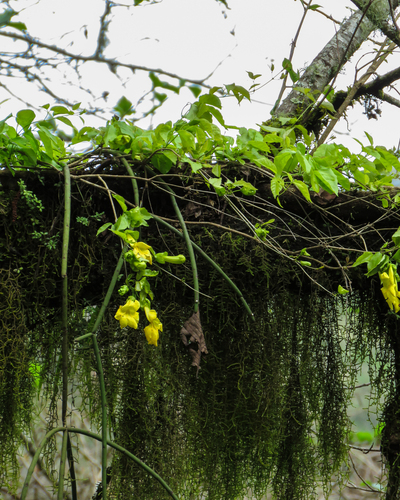
Dolichandra, Genus, spp., Multiple species,
- Genus
- Multiple species
Cat's claw vine
Overview
Dolichandra is a genus of about eight species of woody climbing vines in the family Bignoniaceae, native to Central and South America. Stems are perennial and woody at the base, climbing 6-12 m (20-40 ft) by means of branched, hooked tendrils that grip bark, masonry, and wire. The opposite leaves are pinnately compound, usually divided into two leaflets with a terminal tendril, each leaflet 3-8 cm (1.2-3.2 in) long and glossy green. Tubular to funnel-shaped flowers are borne singly or in small clusters and measure 4-10 cm (1.6-4 in) long, in shades of yellow, orange, and occasionally red. D. unguis-cati, the most widespread species, carries yellow flowers in spring and early summer. Fruit is a flattened linear capsule 20-95 cm (8-37 in) long containing winged seeds. Several species, particularly D. unguis-cati, climb rapidly and have naturalized outside their native range, where the clawed tendrils and underground tubers make established plants hard to remove. In cultivation the genus is grown on fences, pergolas, and walls in frost-free and subtropical climates, and foliage drops where winter temperatures approach freezing.
Native Range
Native to Central and South America, from Mexico and the Caribbean south to Argentina. Species grow at forest margins, along riverbanks, and in disturbed thickets in tropical and subtropical lowlands.Suggested Uses
Grown on pergolas, fences, arbors, and warm walls in frost-free and subtropical gardens. Also trained over wire as a fast screen, or kept on a trellis in containers in cooler regions.How to Identify
Appearance
Size & Dimensions
Height20' - 40'
Width/Spread7' - 13'
Bloom Information
Flowering occurs mainly in spring and early summer, with a concentrated flush over several weeks. In tropical climates some species flower intermittently through the warm season, and individual flowers last only a few days. D. unguis-cati flowers most heavily in a single spring display.
Detailed Descriptions
Flower Description
yellow to orangeFoliage Description
glossy greenGrowing Conditions
Sun Requirements
Requires 4-8 hours of direct sunlight daily
• Full Sun: 6+ hours of direct sunlight
• Partial Shade: 3-6 hours of direct sunlight
• Full Shade: Less than 3 hours of direct sunlight
Care & Maintenance
Care Guide
Grows in full sun to part shade in moist, well-drained soil of moderate fertility. Established vines withstand short dry spells but flower more freely with regular water through the growing season. The genus is frost-sensitive, and in zones colder than USDA 9 it is grown against warm walls or in containers moved under cover for winter. Heavy mature stems and anchoring tubers call for a sturdy permanent support. Where D. unguis-cati is recorded as invasive, self-clinging tendrils and tuber fragments let it spread from gardens into adjacent land.Pruning
Stems are cut back after flowering to limit size and clear tangled growth, since the genus flowers on the current season wood. Renewal pruning to a main framework is tolerated in late winter. Seed capsules removed before they split reduce unwanted seedlings in mild climates.Pruning Schedule
Prune: June–July
summer
Container Growing
Suitable for container growing
Minimum container size: 10 gallons
