Dodecatheon, Genus, hendersonii, Species,
- Genus & species
broad-leaved shooting star
Pacific coast of western North America
Overview
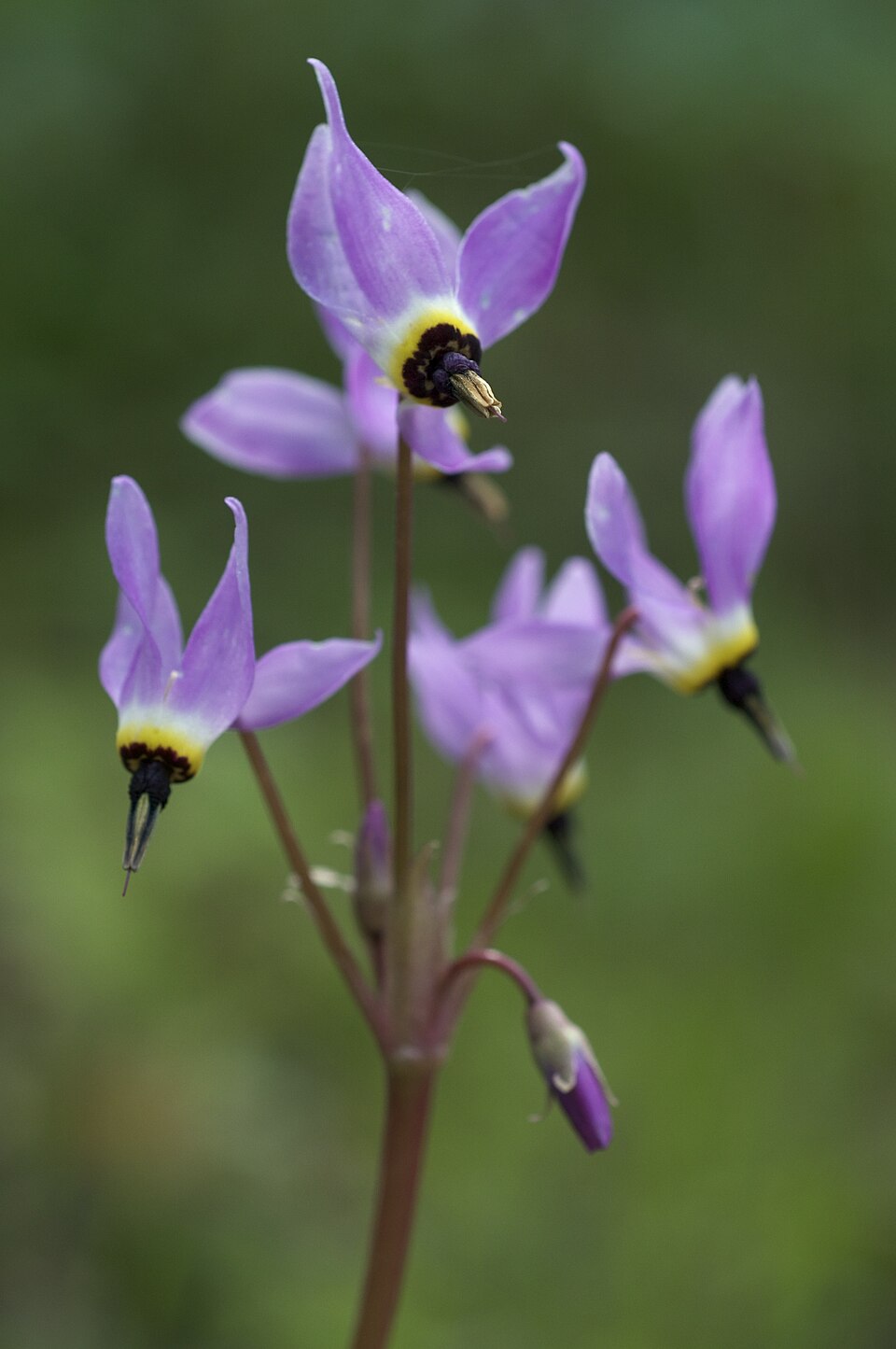
A clump-forming herbaceous perennial reaching 8-16 inches (20-40 cm) tall during flowering and 6-10 inches (15-25 cm) wide, growing from a small cluster of starchy ricegrain bulblets at the base of a short rhizome. Leaves form a basal rosette of broadly oblong-ovate blades 2-5 inches (5-13 cm) long, smooth, deep green, with shallow purple staining at the base. Leafless flower stems (scapes) carry 5-15 nodding flowers in a loose umbel; petals 0.5-0.75 inch (12-18 mm) long, sharply reflexed backward, magenta-purple to lavender-pink, with a yellow band edged in purple at the base of the column of fused dark stamens. Flowering occurs February through May, with peak bloom in March and April depending on elevation. Foliage and stems collapse and disappear by July as plants enter summer dormancy; the bulblets persist underground through summer drought. Seedlings reach flowering size in 4-5 years from autumn-sown seed. Plants are short-lived in cultivation outside their native dry-summer climate, with stands typically declining within 3-4 years on irrigated soils.
Native Range
Native to coastal and montane western North America from southern Vancouver Island and the Olympic Peninsula south through western Washington, Oregon, and California to the central Sierra Nevada. Found in oak woodlands, grassy slopes, prairie remnants, and open coniferous forest from sea level to 5,000 feet (1,500 m).Suggested Uses
Planted in dry-summer woodland gardens, oak-savanna restorations, and unirrigated rock gardens within zones 6-9, at 4-8 inch (10-20 cm) spacing. Pairs with summer-dormant geophytes such as Calochortus and Brodiaea that share the dry-summer cycle. Container culture is rarely sustained beyond 2-3 seasons because crown rot follows even moderate summer watering.How to Identify
Appearance
Size & Dimensions
Height8" - 1'4"
Width/Spread6" - 10"
Bloom Information
February through May, with peak bloom in March and April at lower elevations and into May at higher sites. Each flower lasts 5-8 days; total bloom per stand 3-5 weeks. Cool, moist springs extend bloom by 1-2 weeks; warm springs compress flowering into a 2-week window.
Detailed Descriptions
Flower Description
Magenta-purple to lavender-pinkFoliage Description
Deep greenGrowing Conditions
Sun Requirements
Requires 4-7 hours of direct sunlight daily
• Full Sun: 6+ hours of direct sunlight
• Partial Shade: 3-6 hours of direct sunlight
• Full Shade: Less than 3 hours of direct sunlight
Care & Maintenance
Care Guide
Plants establish slowly from seed sown in autumn and require 8-12 weeks of moist cold stratification at 32-40°F (0-4°C) before germination. Seedlings benefit from supplemental water during their first winter and spring; established plants need no irrigation once foliage senesces in early summer. Crown rot develops in summer-irrigated beds and is the primary cause of stand decline in cultivation. Slugs damage emerging leaves in February and March in coastal climates. Root weevils feed on leaves and bulblets in some Pacific Northwest gardens. Stands are commonly maintained by autumn-sown replacement seed rather than long-lived plants on irrigated soils.Pruning
Withering foliage is left in place after summer dormancy and pulls free from the rootstock by mid-July. Spent flower scapes can be trimmed at the base after seed disperses if self-seeding is not desired. Cutting during active growth is not done, as the few leaves and the single scape carry all photosynthetic activity for the year.Pruning Schedule
Prune: July
summer
Container Growing
Minimum container size: 1 gallons
