Disporopsis, Genus, pernyi, Species,
- Genus & species
Pernyi's disporopsis
Central and southern China (Sichuan, Guizhou, Yunnan, Guangxi; moist shaded woodland understory, forest margins, rocky slopes at 1,600-6,600 feet)
Overview
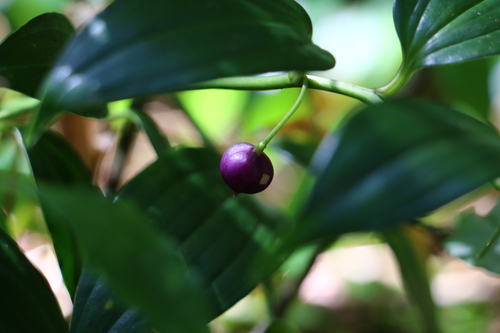
Disporopsis pernyi is a slowly-spreading evergreen rhizomatous perennial in the asparagus family (Asparagaceae) reaching 12–18 inches (30–45 cm) tall and 18–24 inches (45–60 cm) wide at mature colony size. Stems are arching and slender, arising from underground rhizomes that expand the colony 2–4 inches per year. Leaves are alternate, elliptic to lance-ovate, 2.5–5 inches (6–13 cm) long and 1–2 inches (2.5–5 cm) wide, glossy dark green above and paler beneath, with prominent parallel veins. Leaves persist through winter in zones 6–9, which separates this species from the closely related Polygonatum (Solomon's seal), where foliage dies back to the ground every fall. Pendent tubular-bell-shaped flowers 0.4–0.6 inch (1–1.5 cm) long, creamy white with a green-spotted interior, open in leaf axils singly or in pairs in late spring. Small blue-black berries 0.3–0.4 inch (7–10 mm) across ripen in late summer to fall. The species shares a superficial resemblance to Polygonatum but stands apart within the broader Solomon's seal group through its evergreen habit and glossier leaf texture — valued primarily as an evergreen ground-covering shade perennial.
Native Range
Disporopsis pernyi is native to central and southern China, including Sichuan, Guizhou, Yunnan, and Guangxi provinces, where it occurs in moist shaded woodland understory, forest margins, and rocky slopes at 1,600–6,600 feet (500–2,000 m) elevation.Suggested Uses
Grown as a slow-spreading groundcover in shaded borders and woodland gardens at 18–24 inch (45–60 cm) spacing, particularly in dry-shade positions under trees where few other plants thrive. Evergreen foliage carries year-round structural interest in shade compositions, which separates this species from the many deciduous shade perennials that leave winter gaps. Combining with Hosta, ferns, and Epimedium in shade planting schemes builds a layered texture contrast. Container culture suits zones 7–9 where winter protection is not required to hold the evergreen foliage intact.How to Identify
Appearance
Size & Dimensions
Height1' - 1'6"
Width/Spread1'6" - 2'
Bloom Information
Blooms in late spring, typically May through June in zones 6–8. Flowers are pendent in the leaf axils and partially hidden by the foliage above; bloom period lasts 3–4 weeks. In zones 8–9 with mild winters, foliage remains green year-round and bloom timing may shift 2–3 weeks earlier than the zone-6 schedule.
Detailed Descriptions
Flower Description
Creamy white with green-spotted interior; pendent tubular-bell 0.4-0.6 inch long in leaf axilsFoliage Description
Glossy dark green above, paler beneath, elliptic to lance-ovate with prominent parallel veins; evergreenGrowing Conditions
Sun Requirements
Tolerates up to 4 hours of direct sunlight daily
• Full Sun: 6+ hours of direct sunlight
• Partial Shade: 3-6 hours of direct sunlight
• Full Shade: Less than 3 hours of direct sunlight
Care & Maintenance
Care Guide
Grows in partial shade to full shade in moist well-drained humus-rich soil at pH 5.5–7.0, tolerating loam and peat. Hardy to zone 6. Tolerates a shade range from dappled light under deciduous trees to deeper shade beneath conifers; full sun causes leaf scorch and foliage collapse within a single growing season. Plants are spaced 18–24 inches (45–60 cm) apart and spread slowly by rhizome to form a ground-covering colony over 3–5 years. Regular watering supports establishment through the first growing season; established plantings tolerate occasional dry periods of 1–2 weeks in shade but perform more reliably with consistent moisture through the summer season. Amending the planting soil with compost and top-dressing annually in fall with compost or shredded leaf mulch matches the native-habitat humus-rich forest-floor conditions. Congested clumps can be divided in early spring. No serious pest or disease problems. Slugs may feed on foliage in wet springs.Pruning
Damaged, yellowed, or frost-damaged leaves are removed in early spring before new growth emerges. Unlike deciduous Polygonatum, stems do not die back fully in most zones — only damaged stems are cut back, not the entire plant. In zone 6 where winter frosts may damage foliage, dead material is cut back in early spring before new growth begins.Pruning Schedule
Prune: March
early spring
Container Growing
Suitable for container growing
Minimum container size: 3 gallons