Diphylleia, Genus, cymosa, Species,
- Genus & species
umbrella leaf
Southern Appalachian Mountains (VA, NC, TN, GA, SC; cool moist high-elevation stream margins and seepage slopes at 3,000-6,000 feet)
Overview
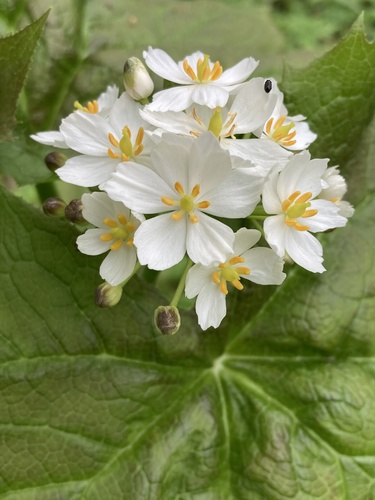
Diphylleia cymosa is a clumping rhizomatous herbaceous perennial in the barberry family (Berberidaceae) reaching 24–36 inches (60–90 cm) tall with a spread of 18–24 inches (45–60 cm). This southern Appalachian native woodland plant carries large umbrella-like peltate (centrally attached) leaves 12–24 inches (30–60 cm) across, deeply cleft into two main lobes with coarsely toothed margins. Leaves emerge in spring as a pair on each flowering stem and are held horizontally above the ground, which produces the umbrella-leaf silhouette that the common name references. Small white six-petaled flowers 0.5 inch (1 cm) across open in terminal cymes in May–June, followed by the primary ornamental feature: bright blue berries 0.3–0.4 inch (8–10 mm) on vivid red pedicels in July–August. The blue-on-red fruit color combination is uncommon among native woodland plants — most native understory fruits run through red, black, and white rather than blue. Leaves become translucent when wet, a trait shared with the Asian relative D. grayi (skeleton flower). Growth rate is slow. Cool consistently-moist shaded conditions are required; drought and heat are not tolerated. Hardy to zone 5.
Native Range
Diphylleia cymosa is native to the southern Appalachian Mountains of eastern North America (Virginia, North Carolina, Tennessee, Georgia, South Carolina), where it occurs in cool moist high-elevation stream margins and seepage slopes at 3,000–6,000 feet (900–1,800 m).Suggested Uses
Grown along shaded stream margins, in bog gardens, and in moist woodland gardens at 18–24 inch (45–60 cm) spacing. The large bold umbrella-leaf foliage carries architectural interest in deep shade where coarse-textured plants are rare. The blue berries on red pedicels add summer color at a time when most shade gardens rely on foliage alone. Rain gardens with consistent moisture support this species. Pairing with ferns, Astilbe, and other moisture-loving shade plants produces a cohesive moist-woodland composition. Dry shade, sunny sites, hot-summer climates, and sites without consistent moisture are not suitable planting contexts given the species native-habitat water dependence.How to Identify
Appearance
Size & Dimensions
Height2' - 3'
Width/Spread1'6" - 2'
Bloom Information
Small white six-petaled flowers 0.5 inch (1 cm) across open in terminal cymes in May–June. The primary ornamental display follows in July–August as bright blue berries 0.3–0.4 inch (8–10 mm) ripen on vivid red pedicels. Bloom duration is 2 weeks; fruit display lasts 3–4 weeks. The blue-on-red fruit color combination pulls strongly against the dark-green shaded-garden background.
Detailed Descriptions
Flower Description
White, small 0.5 inch six-petaled in terminal cymes; followed by bright blue berries on vivid red pedicelsFoliage Description
Medium green, large peltate 12-24 inches across, deeply two-lobed with coarsely toothed marginsGrowing Conditions
Sun Requirements
Requires 1-3 hours of direct sunlight daily
• Full Sun: 6+ hours of direct sunlight
• Partial Shade: 3-6 hours of direct sunlight
• Full Shade: Less than 3 hours of direct sunlight
Care & Maintenance
Care Guide
Grows in deep shade in cool consistently moist to wet humus-rich acidic soil at pH 4.5–6.0, tolerating loam and peat. Hardy to zone 5. Stream-margin or seepage conditions match the native-habitat moisture profile; standard garden borders with periodic dry spells do not support this species. Cool-summer climates that mimic the high-elevation Appalachian range produce the most reliable long-term performance. Slow to establish — 2–3 growing seasons before the colony reaches full umbrella-leaf size. Slugs can damage emerging foliage in wet springs. Heat, drought, and direct sun exposure all cause foliage collapse and plant decline.Pruning
No pruning is required. Dead foliage is removed in late fall after the leaves collapse. The rhizomes are not disturbed — division is done only when absolutely necessary because recovery is slow.Pruning Schedule
Prune: November
fall