Diervilla, Genus, rivularis, Species,
- Genus & species
bush honeysuckle
Southern Appalachian Mountains, eastern United States
Overview
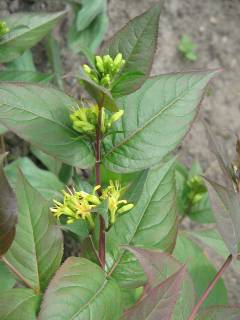
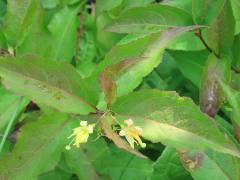
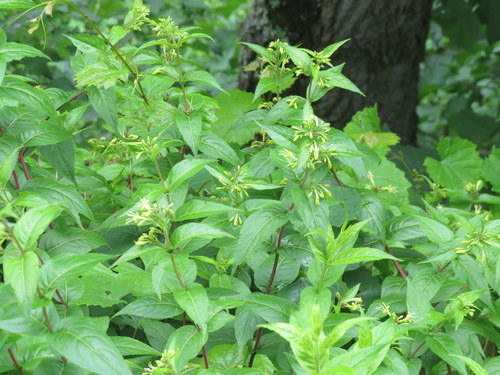
Diervilla rivularis is a deciduous suckering shrub reaching 3-5 feet (90-150 cm) tall and 4-6 feet (120-180 cm) wide at maturity, forming colonies through underground rhizomes that spread 6-12 inches (15-30 cm) per year. Stems are arching and develop reddish-brown bark with shallow exfoliation on older wood. Leaves are opposite, ovate to lance-shaped, 2-4 inches (5-10 cm) long, with serrated margins; spring growth emerges bronze-red, matures to medium green by summer, and turns deep red-purple to burgundy in autumn. Tubular yellow flowers in clusters of 3-7 open from June through August, each bloom 1/2-3/4 inch (1.2-2 cm) long, transitioning to orange-red as flowers age. The species is hardy in USDA zones 4-8, tolerating heat and humidity better than the related D. lonicera. Plants colonize dry rocky slopes and stream banks, indicating tolerance for both lean soils and seasonally moist sites. Native bees, bumblebees, and ruby-throated hummingbirds visit the flowers; the plant supports several specialist moth larvae. Suckering can extend the colony 2-3 feet (60-90 cm) per year in loose, organically rich soils, requiring root barriers in formal plantings.
Native Range
Diervilla rivularis is native to the southeastern United States, occurring in the southern Appalachian Mountains of Tennessee, North Carolina, Georgia, and Alabama at elevations from 800-4,500 feet (240-1,400 m). It grows on rocky slopes, stream banks, and roadsides in well-drained, slightly acidic soils. The species range overlaps with D. sessilifolia but does not extend as far south.Suggested Uses
Diervilla rivularis is used for slope stabilization, naturalized woodland edges, and informal hedge plantings, spaced 4-5 feet (1.2-1.5 m) apart for solid coverage within 3-4 years. The suckering habit makes it suited for erosion control on banks, where root barriers are unnecessary. Plants are used in pollinator gardens and rain gardens with seasonally fluctuating moisture.How to Identify
Appearance
Size & Dimensions
Height3' - 5'
Width/Spread4' - 6'
Bloom Information
Bloom begins in mid June in USDA zones 5-6, continuing through August with sporadic flowers into September in zones 7-8. Each cluster lasts 7-10 days, with new flowers replacing fading ones for an extended display. Yellow petals transition to orange-red as flowers age, often producing a bicolor effect on the same cluster.
Detailed Descriptions
Flower Description
Yellow aging to orange-redFoliage Description
Bronze-red spring; medium green summer; red-purple to burgundy autumnGrowing Conditions
Sun Requirements
Requires 4-12 hours of direct sunlight daily
• Full Sun: 6+ hours of direct sunlight
• Partial Shade: 3-6 hours of direct sunlight
• Full Shade: Less than 3 hours of direct sunlight
Care & Maintenance
Care Guide
Diervilla rivularis grows in full sun to partial shade (4-8 hours direct sun), with denser foliage and stronger fall color in sunnier sites. Well-drained soils of any pH from 5.5-7.5 are tolerated, with the species adapted to dry rocky substrates and slopes. Watering during establishment (first 2 years) requires deep weekly irrigation; mature plants tolerate drought of 3-4 weeks without leaf wilting. Mulching with 2 inches (5 cm) of leaf compost or shredded bark conserves moisture in lean soils. Suckers can be removed annually with a sharp spade to maintain compact plantings or allowed to spread for naturalized colony plantings. No supplemental fertilization is needed in average garden soils.Pruning
Pruning of Diervilla rivularis is done in late winter or early spring before new growth emerges; flowers form on current-season wood. Removal of one-third of the oldest stems at ground level annually maintains vigor and renewal of the colony. Light tip pruning after flowering (August-September) produces a denser habit but reduces autumn flower production by 20-30%.Pruning Schedule
Prune: February–March
winterearly spring