Overview
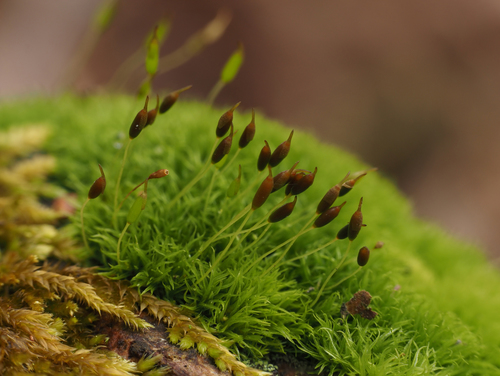
Dicranoweisia cirrata is a small, cushion-forming moss that grows in dense, rounded tufts 0.4–1.2 inches (1–3 cm) tall, yellow-green to mid-green above and brownish within the cushion. The narrow, tapering leaves spread when moist but curl and twist tightly when dry, giving the dry cushion a frizzy look. It is a non-vascular plant without true roots or conducting tissue, attaching by rhizoids and taking up water across its surface. It grows on acidic surfaces raised above the ground, including tree bark, rotting wood, fence rails, thatch, walls, and roof tiles, and tolerates exposure, drought, and some air pollution better than many mosses. The species is common across Britain, Europe, and into North America in cool, humid climates. Spore capsules are frequent, pale brown, egg-shaped, and held upright on yellow stalks (setae) about 0.2–0.4 inch (5–10 mm) tall, with a long-beaked lid. It is sensitive to lime-rich and very dry, sun-baked surfaces, and tends to give way to other mosses on damp, shaded ground.
Native Range
Dicranoweisia cirrata is native across Europe and into North America and parts of Asia, in cool, humid temperate climates. It grows on acidic bark, dead wood, fences, walls, thatch, and roofs, mostly on surfaces raised above the soil.Suggested Uses
Used in moss gardens, terraria, and bonsai and rockwork displays where a small green cushion on bark or stone is wanted. It also colonizes wooden fences, log edging, and roof tiles in naturalistic settings.How to Identify
Appearance
Bloom Information
As a moss, it produces no flowers. Spore capsules are common and mature mainly in winter and early spring, held upright on slender yellow stalks. New plants also arise from detached shoot fragments.
Detailed Descriptions
Foliage Description
yellow-green to mid-greenGrowing Conditions
Water & Climate
Water Needs