Overview
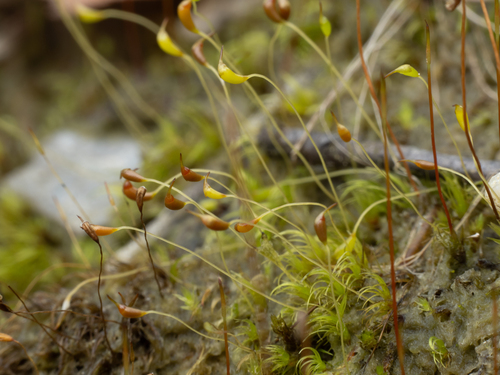
Dicranella is a genus of small mosses in the family Dicranellaceae, with around 100 species found on every continent. They are pioneer mosses that colonise bare, disturbed mineral soil such as clay banks, ditch sides, path edges, field margins, and recently cleared ground, often forming low green to yellow-green turfs. The slender, upright shoots are usually only 0.1-0.8 inch (3-20 mm) tall and carry narrow, tapering leaves that in many species curve to one side, giving the turf a combed look. Spore capsules are produced freely on wiry stalks, often yellow or reddish, lifting the cylindrical, sometimes curved or ribbed capsules above the leaves; abundant spores let the mosses spread quickly onto new bare ground. They grow in open to lightly shaded sites and are short-lived colonists, fading as larger plants and other mosses take over the soil. Several species are common on acidic soils, while others occupy neutral or base-rich clays. Because they are tiny and weedy they are rarely cultivated, appearing on their own on soil in gardens, pots, and greenhouses. Like all mosses they have no true roots and absorb water through their surfaces.
Native Range
Cosmopolitan, occurring on bare, disturbed mineral soil across all continents, including North and South America, Europe, Asia, Africa, Australia, and the margins of Antarctica.Suggested Uses
Of mainly botanical interest as a soil-colonising moss rather than a cultivated plant. The turfs can stabilise the surface of bare, damp soil on banks and disturbed ground until larger plants establish.How to Identify
Appearance
Colors
Foliage Colors
Fall Foliage Colors
Bloom Information
As mosses, Dicranella do not flower and reproduce by spores. Spore capsules form freely, ripening mainly in autumn, winter, and spring depending on species and climate. The capsules release abundant spores that colonise fresh bare soil.
Detailed Descriptions
Foliage Description
green to yellow-greenGrowing Conditions
Sun Requirements
Requires 2-8 hours of direct sunlight daily
• Full Sun: 6+ hours of direct sunlight
• Partial Shade: 3-6 hours of direct sunlight
• Full Shade: Less than 3 hours of direct sunlight
Water & Climate
Water Needs
