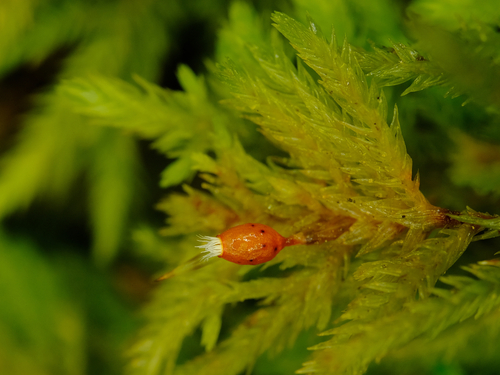
Dendroalsia, Genus, abietina, Species,
- Genus & species
dendroalsia moss
Western North America (Pacific Coast)
Overview
Dendroalsia abietina is a pleurocarpous moss in the family Leucodontaceae and the only species in its genus. It forms colonies of arching to pendant stems 2-8 inches (5-20 cm) long that grow from a creeping base anchored to bark or rock. The stems are pinnately branched, giving each a feather-like outline, and bear small overlapping leaves about 0.08-0.12 inch (2-3 mm) long. Foliage is dark green to yellowish-green when moist. During dry periods the stems curl inward and the leaves press against them, a response that reduces water loss and changes the colony from open and feathery to tightly curved. Spore capsules form on short stalks and ripen in the cooler, wetter months. The moss grows on the trunks and lower branches of hardwood trees, especially oaks, and on shaded boulders and rock faces, often near seasonal streams. It is restricted to regions with a Mediterranean climate of wet winters and dry summers and does not tolerate continuously waterlogged surfaces. Colonies expand slowly and depend on stable host surfaces and steady winter moisture, which makes them slow to recover once disturbed.
Native Range
Dendroalsia abietina is native to western North America, from Washington south through Oregon and California into Baja California, Mexico. It occurs in the Coast Ranges, Sierra Nevada foothills, and other low- to mid-elevation areas with a Mediterranean climate.Suggested Uses
Dendroalsia abietina appears in woodland, streamside, and shaded rock-garden settings on bark and stone within its native range. It is used in naturalistic and conservation plantings rather than as a container or bedding plant. It holds moisture on shaded surfaces and contributes to native moss communities.How to Identify
Appearance
Size & Dimensions
Height2" - 8"
Width/Spread1' - 2'
Colors
Fall Foliage Colors
Bloom Information
Mosses do not flower. Spore capsules form on short stalks and mature through the wet season from late fall into spring, releasing spores as they dry. Reproduction also occurs vegetatively as stem fragments root on new surfaces.
Detailed Descriptions
Foliage Description
dark green to yellowish-greenGrowing Conditions
Sun Requirements
Tolerates up to 4 hours of direct sunlight daily
• Full Sun: 6+ hours of direct sunlight
• Partial Shade: 3-6 hours of direct sunlight
• Full Shade: Less than 3 hours of direct sunlight