Delairea, Genus, odorata, Species,
- Genus & species
Cape-ivy
Overview
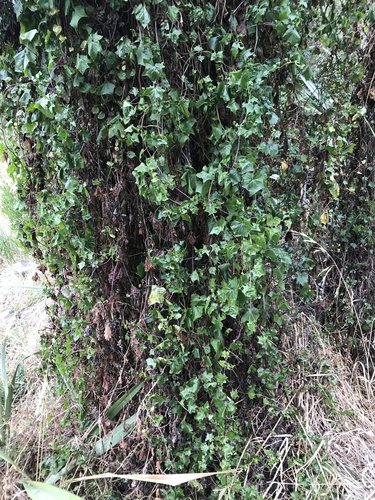
Delairea odorata is an evergreen, twining perennial vine with fleshy, ivy-shaped leaves 1-3 inches (2.5-8 cm) wide, each with five to seven pointed lobes and a glossy green surface. The slender stems twine over supports and trail across the ground, rooting at the nodes and reaching 10-15 feet (3-4.5 m) or more in a season. Small yellow flower heads about 0.2 inch (5 mm) across gather in dense, rounded clusters in winter, followed by tufted, wind-borne seed. The plant spreads both by seed and by stem and root fragments, forming dense mats that smother low vegetation and climb into shrubs and trees. All parts contain pyrrolizidine alkaloids that are poisonous to grazing livestock and can taint milk. It grows quickly in mild, frost-free coastal climates with moist soil and partial shade. Delairea odorata is listed as an invasive weed in California, the Pacific Northwest, Australia, and other mild regions, where it displaces native plants along streams and coastal scrub. A limitation for any garden use is this rapid spread and the difficulty of removing established root fragments.
Native Range
Delairea odorata, also called Cape-ivy or German-ivy, is native to the moist forests and mountains of southern Africa, mainly South Africa. It has been carried worldwide as an ornamental and has naturalised in mild coastal regions of North America, Australia, New Zealand, and Europe.Suggested Uses
Once grown as a fast cover for fences, banks, and hanging containers in mild climates. Current guidance in California, Oregon, and Australia is removal rather than planting, because the vine escapes gardens and invades natural areas. Where it persists, it is contained far from waterways and wildland edges.How to Identify
Appearance
Size & Dimensions
Height10' - 15'
Width/Spread3' - 6'
Bloom Information
Small yellow flower heads open in winter, mainly December to February in mild climates, gathered in rounded clusters at the stem tips. The flowers are followed by tufted seed carried on the wind. Flowering is sparse or absent in cooler regions, where the plant spreads mainly by stem fragments.
Detailed Descriptions
Foliage Description
greenGrowing Conditions
Sun Requirements
Requires 3-8 hours of direct sunlight daily
• Full Sun: 6+ hours of direct sunlight
• Partial Shade: 3-6 hours of direct sunlight
• Full Shade: Less than 3 hours of direct sunlight
Care & Maintenance
Care Guide
Delairea odorata grows in partial shade to full sun and moist, fertile soil in frost-free or nearly frost-free climates. It roots readily from stem fragments and grows fast over a single season, climbing or trailing across any support. The plant tolerates poor light, salt air, and a range of soils, which contributes to its spread outside cultivation. Frost kills the topgrowth, though roots can resprout in mild winters. Because the stems root at every node, even small pieces left in the soil regrow into new plants.Pruning
Stems can be cut back at any time to limit spread, and clippings are bagged rather than composted because fragments take root. Cutting alone rarely kills the plant, since the roots resprout. Repeated removal of regrowth over several seasons is needed to exhaust established roots.Container Growing
Suitable for container growing
Minimum container size: 3 gallons