Cyrtostachys, Genus, renda, Species,
- Genus & species
sealing wax palm
Southeast Asia (Malaysia, Thailand, Sumatra, Borneo)
Overview
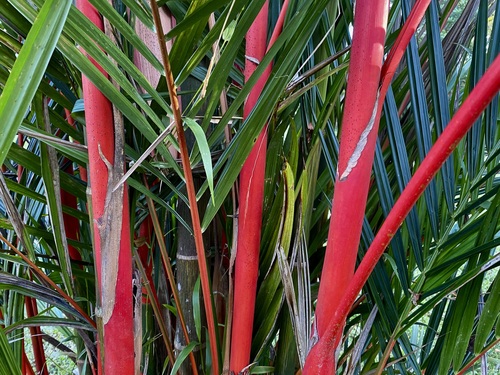
Cyrtostachys renda is the sealing wax palm (lipstick palm), growing 120–300 inches (300–750 cm) tall as a clumping multi-stemmed palm. The bright red crownshaft (the smooth tubular structure below the frond canopy formed by overlapping leaf sheaths) and the red upper leaf sheaths are the defining feature — the red coloring resembles the sealing wax used historically on letters, giving the common name. Green pinnate fronds 36–60 inches (90–150 cm) with narrow leaflets. The red crownshaft color develops with maturity — juvenile palms have green crownshafts that gradually redden over years. Clumping: multiple stems arise from the base, forming a multi-trunked grove. Strictly tropical: no frost tolerance; foliage damage below 45°F (7°C) and killed below 35°F (2°C). Native to peat swamp forests of Southeast Asia (Malaysia, Thailand, Sumatra, Borneo) — the natural habitat is waterlogged acidic peat soil with high humidity. In cultivation, requires consistently moist to wet acidic soil (pH 5.0–6.5) and high humidity. Dry air causes brown leaf tips. Slow-growing — 6–12 inches (15–30 cm) per year. Green branched inflorescences below the crownshaft produce small black fruit 0.4 inch (10 mm). Non-toxic. Full sun to partial shade. Containers of 15+ gallons (60+ liters) in warm greenhouses outside tropical zones. Zone 11+ only outdoors.
Native Range
Native to the peat swamp forests of Southeast Asia — Malaysia, southern Thailand, Sumatra, and Borneo. Grows in waterlogged acidic peat soils with high humidity.Suggested Uses
Grown outdoors in zone 11+ in consistently moist acidic soil, or in containers of 15+ gallons (60+ liters) in warm tropical greenhouses. The red crownshaft develops with maturity. Strictly tropical — no frost tolerance. Non-toxic.How to Identify
Appearance
Size & Dimensions
Height10' - 25'
Width/Spread6' - 10'
Bloom Information
Green branched inflorescences below the crownshaft year-round in tropical conditions. Small black fruit 0.4 inch (10 mm). The red crownshaft — not the flowers — is the year-round feature.
Detailed Descriptions
Flower Description
Green, in branched inflorescence below crownshaftFoliage Description
Green pinnate fronds; crownshaft and upper leaf sheaths bright redGrowing Conditions
Sun Requirements
Requires 6-10 hours of direct sunlight daily
• Full Sun: 6+ hours of direct sunlight
• Partial Shade: 3-6 hours of direct sunlight
• Full Shade: Less than 3 hours of direct sunlight
Care & Maintenance
Care Guide
Full sun to partial shade. Consistently moist to wet acidic soil pH 5.0–6.5. High humidity required — dry air browns leaf tips. Strictly tropical: no frost tolerance. Slow-growing (6–12 inches / 15–30 cm per year). The red crownshaft develops with maturity. Non-toxic. Zone 11+ outdoors.Pruning
Remove dead or yellowed fronds at the base of the crownshaft. Do not remove green fronds — this weakens the palm. Dead fronds detach cleanly from the smooth crownshaft. No other pruning needed.Container Growing
Suitable for container growing
Minimum container size: 15 gallons