Cryptotaenia, Genus, canadensis, Species,
- Genus & species
honewort
Overview
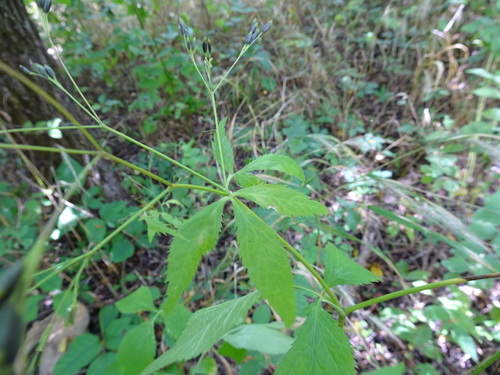
Cryptotaenia canadensis is an upright herbaceous perennial 1-3 feet (30-90 cm) tall, growing from a short crown in moist woodland soil. The leaves are divided into three broad, coarsely toothed, often irregularly lobed leaflets 2-5 inches (5-13 cm) long, bright green and thin, on long petioles that clasp the stem. From late spring into summer, tiny white flowers open in sparse, uneven, branched umbels held above the foliage; the umbels are loose and few-flowered, unlike the flat dense heads of many carrot-family relatives. Slender ribbed seeds about 0.25 inch (6 mm) long follow and ripen dark by fall. The whole plant has a mild celery-parsley scent, and the young leaves and stems are eaten as a herb, the North American counterpart of Japanese mitsuba. It spreads by seed and forms loose colonies in damp shade across eastern North America. One trade-off is heavy self-sowing, since seed scatters freely and seedlings appear through nearby beds.
Native Range
Native to eastern North America, from New Brunswick and Manitoba south to Georgia and Texas. It grows in moist deciduous woods, floodplains, ravines, and shaded stream banks on rich soils.Suggested Uses
Used in shade and woodland gardens, native plantings, and rain gardens on moist soils. It is grown as a culinary herb for its mitsuba-like leaves and stems and naturalized as a shade ground layer.How to Identify
Appearance
Size & Dimensions
Height1' - 3'
Width/Spread1' - 1'6"
Bloom Information
Detailed Descriptions
Foliage Description
Bright greenGrowing Conditions
Sun Requirements
Tolerates up to 4 hours of direct sunlight daily
• Full Sun: 6+ hours of direct sunlight
• Partial Shade: 3-6 hours of direct sunlight
• Full Shade: Less than 3 hours of direct sunlight
Care & Maintenance
Care Guide
Grows in part to full shade in moist, fertile, humus-rich soils at pH 5.5-7.0, and tolerates short dry spells once established. It needs steady moisture and shade, scorching and wilting in full sun or dry ground. Hardy in zones 4-8, it dies back in winter and returns from the crown in spring. It self-sows heavily, so seedlings spread unless the seed heads are removed before ripening. The young leaves and stems are cut for use as a culinary herb.Pruning
Maintenance is minimal. Seed heads are cut off before they ripen to curb self-sowing, and spent stems are removed in late fall. Cutting young growth for the kitchen also keeps plants compact.Pruning Schedule
Prune: July & November
summerfall
Container Growing
Suitable for container growing
Minimum container size: 2 gallons