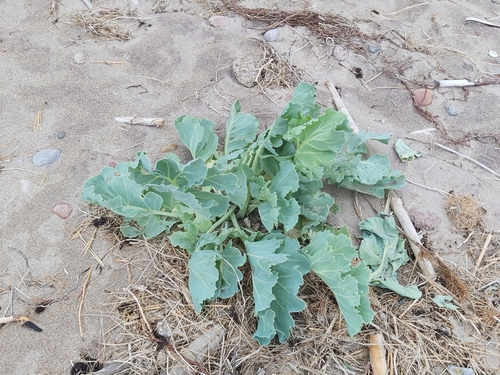
Crambe, Genus, maritima, Species,
- Genus & species
sea kale
European coastlines (Black Sea and Baltic Sea through Atlantic coasts of Britain, France, and Scandinavia; shingle beaches, sea cliffs, sandy dunes)
Overview
Crambe maritima is a mounding herbaceous perennial in the mustard family (Brassicaceae) reaching 24–36 inches (60–90 cm) tall with a spread of 24–36 inches (60–90 cm). The plant is grown for bold blue-gray glaucous foliage and dense domed flower clusters. Leaves are thick fleshy and wavy-edged (crisped), 6–12 inches (15–30 cm) long, held in a loose basal rosette — the color and texture resemble ornamental kale but this is a long-lived woody-crowned perennial rather than an annual cole crop. Dense rounded panicles of small fragrant white four-petaled flowers (the typical cross-flower pattern of the Brassicaceae family) open in June–July, forming domed clusters 12–18 inches (30–45 cm) across above the foliage rosette. Flowers draw heavy pollinator activity throughout the bloom period. The plant develops a deep thick taproot and a woody crown, which supports long-term persistence in place but resists transplanting once established. Growth rate is moderate. Hardy to zone 4. Foliage can be blanched and eaten as a vegetable, reflecting the species historical use as a European coastal crop harvested from wild populations on shingle beaches. Salt spray, poor sandy soil, and wind exposure are all tolerated thanks to the maritime native habitat. Foliage dies back to the crown in winter. Slugs and caterpillars (cabbage-family pests) can damage the rosette foliage during the growing season.
Native Range
Crambe maritima is native to European coastlines, from the Black Sea and Baltic Sea to the Atlantic coasts of Britain, France, and Scandinavia, where it occurs on shingle beaches, sea cliffs, and sandy dune systems.Suggested Uses
Grown as a specimen in coastal gardens, gravel gardens, and Mediterranean-style borders at 24–30 inch (60–75 cm) spacing. The bold blue-gray foliage contrasts in texture with narrow-leaved companion plants such as Stipa tenuissima and Nepeta × faassenii. Rock gardens, raised beds, and seaside plantings match the native-habitat soil and exposure profile. Dense white flower domes draw pollinators during the June–July bloom window. The edible aspect (young shoots blanched and eaten as a vegetable) places this species in dual ornamental-and-culinary garden contexts. Wet heavy clay soils and fully shaded positions are not suitable given the drainage requirement and the full-sun habitat preference.How to Identify
Appearance
Size & Dimensions
Height2' - 3'
Width/Spread2' - 3'
Bloom Information
Dense rounded panicles of small fragrant white four-petaled flowers form domed clusters 12–18 inches (30–45 cm) across in June–July. Flowers are honey-scented with the fragrance detectable at close range. Bloom duration is 3–4 weeks. The pollinator activity through the bloom period is heavy — honeybees, bumblebees, and a range of solitary bee species visit the flowers.
Detailed Descriptions
Flower Description
White; dense rounded panicles forming domes 12-18 inches across; honey-scentedFoliage Description
Blue-gray glaucous, thick fleshy wavy-edged (crisped) leaves 6-12 inches long in basal rosetteGrowing Conditions
Sun Requirements
Requires 6-12 hours of direct sunlight daily
• Full Sun: 6+ hours of direct sunlight
• Partial Shade: 3-6 hours of direct sunlight
• Full Shade: Less than 3 hours of direct sunlight
Care & Maintenance
Care Guide
Grows in full sun in well-drained sandy to gravelly soil at pH 6.0–8.0, tolerating sand, loam, rocky, and chalk substrates. Hardy to zone 4. Poor alkaline and rocky soils are tolerated, reflecting the maritime native habitat on calcareous coastal shingles. The deep taproot supports drought tolerance once the plant is established, and the same taproot structure means the plant resists transplanting — installation in the permanent garden position reduces transplant losses. Salt-spray tolerance extends the use to coastal and seaside gardens. Soil drainage is the single most important planting requirement; wet winter soils produce crown rot even in otherwise cold-hardy positions. Slugs and caterpillars (cabbage-family pests) can damage the rosette foliage during the growing season. Foliage dies back to the crown in fall; marking the location in the bed avoids accidental disturbance during winter bed work.Pruning
Spent flower stalks are cut after flowering in August to tidy the plant form and prevent self-seeding. Dead foliage is removed after it dies back in fall. No other pruning is required. The plant regenerates from the woody crown each spring and does not benefit from structural cuts during active growth.Pruning Schedule
Prune: August
summer
Container Growing
Suitable for container growing
Minimum container size: 5 gallons