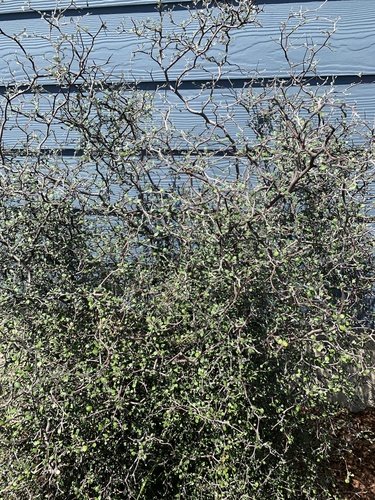
Corokia, Genus, cotoneaster, Species,
- Genus & species
wire-netting bush
New Zealand (lowland to montane forests, scrublands, rocky habitats; both North and South Islands)
Overview
Corokia cotoneaster is a slow-growing intricately-branched evergreen shrub in the argyll family (Argophyllaceae) reaching 5–8 feet (1.5–2.4 m) tall with a spread of 4–6 feet (1.2–1.8 m). The plant is grown primarily for its zigzag branching pattern — dark brown to black stems interlock at sharp angles and produce a dense wiry tangled silhouette that recalls a panel of wire netting, which gives the cultivar its common name 'wire-netting bush'. Leaves are tiny 0.25–0.5 inch (6–12 mm) long, spoon-shaped (spatulate), dark green above, and silvery-white below with dense tomentum on the underside. The small leaf size combined with the dense branching creates a minimal almost-leafless appearance from a distance. Small star-shaped bright yellow flowers 0.3 inch (8 mm) across open in May–June scattered among the stems, followed by small orange-to-red berries (drupes) 0.25 inch (6 mm) across in fall. Growth rate is slow at 3–6 inches (8–15 cm) per year. The plant is marginally hardy to about 15°F (−9°C), which places it at the edge of USDA zone 8 and reliable only in zone 9 or warmer; severe winters produce dieback even in sheltered zone-8 positions. New Zealand origin accounts for the salt-spray and wind tolerance that suits coastal planting.
Native Range
Corokia cotoneaster is native to New Zealand, where it occurs in lowland to montane forests, scrublands, and rocky habitats throughout both the North and South Islands.Suggested Uses
Grown as a specimen, in rock gardens, and in containers of 5 gallons (19 L) or larger at 3–4 foot (0.9–1.2 m) spacing. The wiry dark silhouette carries architectural winter interest that reads differently from broad-leaved evergreen or deciduous shrubs. Coastal gardens suit the salt and wind tolerance. Mediterranean-style and xeriscape plantings match the drought-tolerance profile. The dark intricate branching contrasts with small-scale ground covers such as Thymus serpyllum and silver-leaved companion plants such as Artemisia selections. Japanese-inspired and bonsai-influenced garden styles align with the naturally sculptural habit. The cultivar is not suited to cold exposed sites in zone 8 or to formal clipped hedging roles.How to Identify
Appearance
Size & Dimensions
Height5' - 8'
Width/Spread4' - 6'
Bloom Information
Small star-shaped bright yellow flowers 0.3 inch (8 mm) across open scattered among the wiry branches in May–June. Small orange-to-red berries (drupes) 0.25 inch (6 mm) across ripen in fall. Bloom duration is 2–3 weeks. The flower display is scattered through the dense branching rather than massed, and the berries read as a secondary ornamental feature against the stem silhouette.
Detailed Descriptions
Flower Description
Bright yellow; small star-shaped 0.3 inch across scattered among the wiry branchesFoliage Description
Tiny 0.25-0.5 inch spatulate leaves; dark green above, silvery-white beneath with dense tomentumGrowing Conditions
Sun Requirements
Requires 6-12 hours of direct sunlight daily
• Full Sun: 6+ hours of direct sunlight
• Partial Shade: 3-6 hours of direct sunlight
• Full Shade: Less than 3 hours of direct sunlight
Care & Maintenance
Care Guide
Grows in full sun in well-drained soil at pH 5.5–7.5, tolerating sand, loam, and rocky substrates. Poor and rocky soils are tolerated given the New Zealand native habitat includes rocky hillside positions. Established plants tolerate drought. Winter hardiness limits the cultivar to USDA zones 8b–10, and zone-8a positions require a south-facing wall or other winter-protection structure given the roughly 15°F (−9°C) minimum hardiness threshold. Soil drainage is the single most important planting requirement — wet winter soils produce root rot in the absence of saturated-soil tolerance. Wind exposure and coastal salt-spray are tolerated, which extends use to seaside gardens.Pruning
Minimal pruning is required. The naturally dense interlocking form develops without structural intervention. Light interior thinning works if congestion reduces light penetration to inner stems. Pruning timing is late spring after flowering. Formal shearing into hedge or topiary shapes destroys the zigzag architecture that carries the ornamental value and is not recommended.Pruning Schedule
Prune: June
late spring
Container Growing
Suitable for container growing
Minimum container size: 5 gallons