AnRo0002, no rights reserved (CC0) · Wikimedia Commons
Conyza canadensis
horseweed
North America (native); now naturalized worldwide except Antarctica
SunFull Sun – Part Shade
Overview
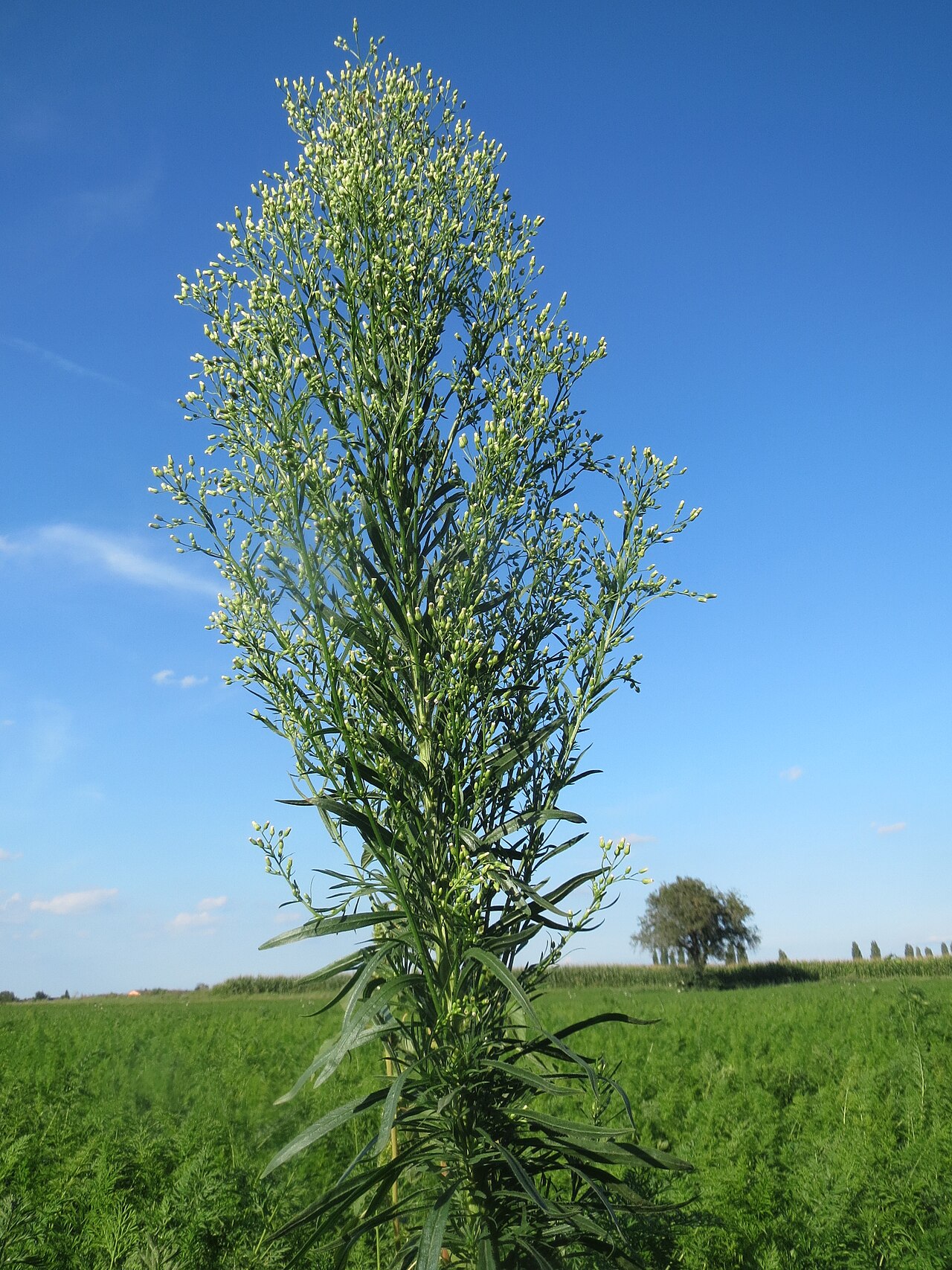
Conyza canadensis (syn. Erigeron canadensis) is an erect summer or winter annual in the daisy family (Asteraceae) reaching 12–72 inches (30–180 cm) tall and 6–18 inches (15–45 cm) wide. Stems are erect, usually unbranched below the inflorescence, hairy, and densely leafy. Basal rosette leaves are oblanceolate, 2–4 inches (5–10 cm) long, coarsely toothed, and often withering by flowering time. Stem leaves are numerous and crowded, linear, 1–4 inches (2.5–10 cm) long, entire to slightly toothed, progressively smaller upward. The inflorescence is a large elongated terminal panicle 4–12 inches (10–30 cm) long carrying hundreds to thousands of small flower heads. Each head is 0.1–0.2 inch (3–5 mm) across with inconspicuous white ray florets barely exceeding the involucre and a yellow disc. A single plant produces 50,000–200,000 seeds bearing a hair-like pappus for long-distance wind dispersal; seeds have been detected at altitudes above 3,000 feet (900 m) in air column sampling. Seeds germinate in both fall and spring, producing winter annual and summer annual cohorts. The species was the first weed to evolve widespread resistance to glyphosate, and glyphosate-resistant populations are now documented in more than 25 U.S. states.
Native Range
Conyza canadensis is native to North America, occurring across all 50 U.S. states, all Canadian provinces, and into Mexico and Central America. The species is found in cultivated fields, no-till cropland, orchards, vineyards, roadsides, construction sites, sidewalk cracks, and virtually any disturbed ground from sea level to approximately 8,000 feet (2,400 m). Now naturalized on every continent except Antarctica.Suggested Uses
Used in weed science education as a primary example of glyphosate resistance evolution. Studied in aerobiology and seed dispersal ecology because of the long-distance wind transport of pappus-bearing seeds. Included in agricultural weed identification curricula. Native to North America and historically used in indigenous ethnobotany for various medicinal applications. Intentional garden planting is not a standard use.How to Identify
Appearance
Size & Dimensions
Height1' - 6'
Width/Spread6" - 1'6"
Bloom Information
Flowers from July through October. Individual flower heads bloom for 3–5 days. The panicle produces new heads from the bottom upward over 6–8 weeks. In the Pacific Northwest, peak flowering occurs in August and September. Seeds mature 2 weeks after flowering and are immediately wind-dispersed. Self-pollinating; insect visitation is minimal.
Detailed Descriptions
Flower Description
White to pale yellow; tiny flower heads 0.1–0.2 inch (3–5 mm) across with inconspicuous ray florets barely exceeding the involucre and a yellow disc; massed in a 4–12 inch (10–30 cm) terminal panicleFoliage Description
Medium green; basal leaves oblanceolate, coarsely toothed; stem leaves linear, numerous and crowded, entire to slightly toothedGrowing Conditions
Sun Requirements
Requires 6-12 hours of direct sunlight daily
• Full Sun: 6+ hours of direct sunlight
• Partial Shade: 3-6 hours of direct sunlight
• Full Shade: Less than 3 hours of direct sunlight