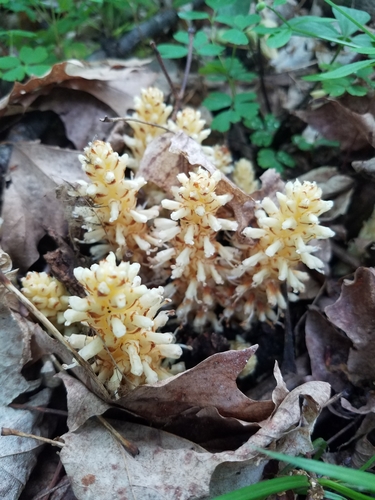
Conopholis, Genus, americana, Species,
- Genus & species
American cancer-root
SunFull Shade
HardinessZones 3–9
Overview
Conopholis americana is a non-photosynthetic perennial that parasitizes the roots of oaks, drawing all its water and nutrients from the host through a swollen underground tubercle. It lacks chlorophyll and produces no green leaves. Above ground it appears as clustered, yellowish-brown to tan spikes 3-8 inches (8-20 cm) tall, each densely covered in overlapping scale-like bracts that give the look of a pinecone or ear of corn. Small tubular flowers, pale yellow and two-lipped, open between the scales from spring into early summer. The spikes darken to brown and turn woody as they age, persisting through the season after the flowers fade. The plant forms dense clumps where a host root system is colonized, often reappearing in the same spot for years as the underground structure enlarges. Seeds are minute and dust-like, dispersed near the parent and germinating only in response to chemical signals from a suitable oak root. C. americana grows in mature deciduous and mixed forests with established oaks, in leaf-littered, shaded soil. It cannot be transplanted or cultivated apart from its host and is rarely seen outside intact woodland. Bears and deer feed on the fleshy spikes, an association reflected in the name bear corn.
Native Range
Conopholis americana is native to eastern North America, from Nova Scotia and Ontario south to Florida and west to Wisconsin and Texas, wherever oak forests occur. It grows in the leaf litter of mature deciduous and mixed woodland.Suggested Uses
C. americana is not a garden plant and is not sold in the nursery trade. It is encountered in natural oak woodland and is of interest in native-plant study and woodland ecology. Intact forest with mature oaks is needed for it to occur.How to Identify
Appearance
Size & Dimensions
Height3" - 8"
Width/Spread3" - 6"
Bloom Information
C. americana flowers from April to June, soon after the spikes emerge. The small tubular flowers open in sequence along each spike, pollinated by bees and other insects. By midsummer the spikes turn brown and woody and shed dust-like seeds.
Detailed Descriptions
Foliage Description
none; yellowish-brown scalesGrowing Conditions
Sun Requirements
Tolerates up to 2 hours of direct sunlight daily
• Full Sun: 6+ hours of direct sunlight
• Partial Shade: 3-6 hours of direct sunlight
• Full Shade: Less than 3 hours of direct sunlight
Water & Climate
Frost Tolerance