Comptonia, Genus, peregrina, Species,
- Genus & species
sweet fern
Eastern North America (Nova Scotia and Manitoba south to North Carolina and west to Minnesota); dry acidic sandy or gravelly soils on hillsides, road cuts, pine barrens, and old sand pits, often in fire-disturbed habitats.
Overview
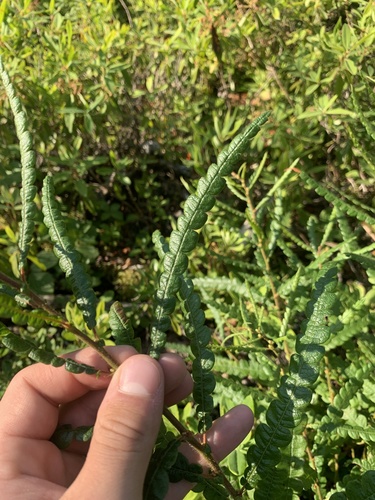
Comptonia peregrina is a low suckering native shrub in the bayberry family (Myricaceae) growing 24-48 inches (60-120 cm) tall and spreading 48-96 inches (120-240 cm) wide by underground rhizomes. The common name sweet fern is a misnomer in two ways: the plant is not a fern (it is a flowering woody dicot), and the name refers to the deeply lobed narrow dark green leaves that resemble the fronds of true ferns rather than to the foliage of any actual fern. The foliage is intensely aromatic when brushed or crushed, releasing a spicy-sweet resinous scent that is the most identifying trait of the species in the field. The species is the sole member of its genus, with no close relatives in the bayberry family beyond Myrica and Morella. Inconspicuous greenish-brown catkins appear in early spring before the leaves fully emerge; the plant is monoecious, bearing separate male and female catkins on the same individual, and small bur-like fruit clusters develop in late summer. Like its relatives in the bayberry family, Comptonia bears root nodules containing nitrogen-fixing Frankia bacteria, an actinorhizal symbiosis that allows the species to grow on extremely poor acidic sandy soils where most plants cannot survive (the actinorhizal symbiosis is functionally similar to the Rhizobium symbiosis in legumes but uses a different bacterial partner). The vigorous suckering habit can form extensive colonies on sandy hillsides, and the species is often the dominant component of regrowth on burned-over pine barrens in the northeastern United States. Transplanting is difficult because the nitrogen-fixing root symbiosis is sensitive to disturbance; container-grown plants establish more reliably than bare-root or field-dug material. The species does not tolerate alkaline, clay, or wet soils, and the acidic-soil requirement is the principal cultivation constraint outside the native range. Deer avoid the aromatic foliage. The species has a long history of indigenous and early American medicinal use as a tea, and the fresh or dried leaves carry a long shelf life of fragrance for sachet and potpourri use.
Native Range
Comptonia peregrina is native to eastern North America, with a range from Nova Scotia and Manitoba south to North Carolina and west to Minnesota. The species grows on dry acidic sandy or gravelly soils on hillsides, road cuts, pine barrens, and old sand pits, often in areas that have been disturbed by fire. The native range is the cooler northeastern and Great Lakes regions, with the species disappearing in the warmer southeastern coastal plain where the acidic-sandy-soil habitat is occupied by other shrub species adapted to the longer summer growing season.Suggested Uses
Used for erosion control on dry acidic sandy slopes and roadcuts, where the suckering rhizomatous spread builds a low woody groundcover that holds soil. The nitrogen-fixing actinorhizal root symbiosis makes the species valuable for soil restoration on degraded infertile sites, where the plant can grow in conditions that exclude most other woody species. Native plant restorations in pine barrens and along highway embankments use the species as a structural component, and the plant works well combined with bayberry (Myrica pensylvanica), low-bush blueberry (Vaccinium angustifolium), and wintergreen (Gaultheria procumbens) on shared acidic-sandy sites. The aromatic foliage works in potpourri and dried arrangements with a multi-month shelf life. The species is not suited to formal gardens, irrigated fertile beds, or container culture because the acidic-soil and Frankia symbiosis requirements do not transfer to amended garden soil.How to Identify
Appearance
Size & Dimensions
Height2' - 4'
Width/Spread4' - 8'
Colors
Bloom Information
Inconspicuous greenish-brown catkins appear in April through May before the leaves fully emerge, with a 2-week active flowering window. The flowers have no ornamental value and are barely visible from a few feet away, but they are wind-pollinated as part of the family's broader reproductive strategy. Small bur-like fruit clusters develop in late summer, again with no ornamental impact, but the seeds are dispersed by ants in a myrmecochory relationship that the species shares with several other eastern woodland plants.
Detailed Descriptions
Foliage Description
Dark green; narrow deeply lobed leaves resembling fern fronds carried on woody stems, releasing a strong spicy-sweet resinous scent when brushed or crushedGrowing Conditions
Sun Requirements
Requires 4-10 hours of direct sunlight daily
• Full Sun: 6+ hours of direct sunlight
• Partial Shade: 3-6 hours of direct sunlight
• Full Shade: Less than 3 hours of direct sunlight