Codiaeum, Genus, variegatum, Species,
- Genus & species
Croton
Maluku Islands, New Guinea, Indonesia, northern Australia and the western Pacific islands
Overview
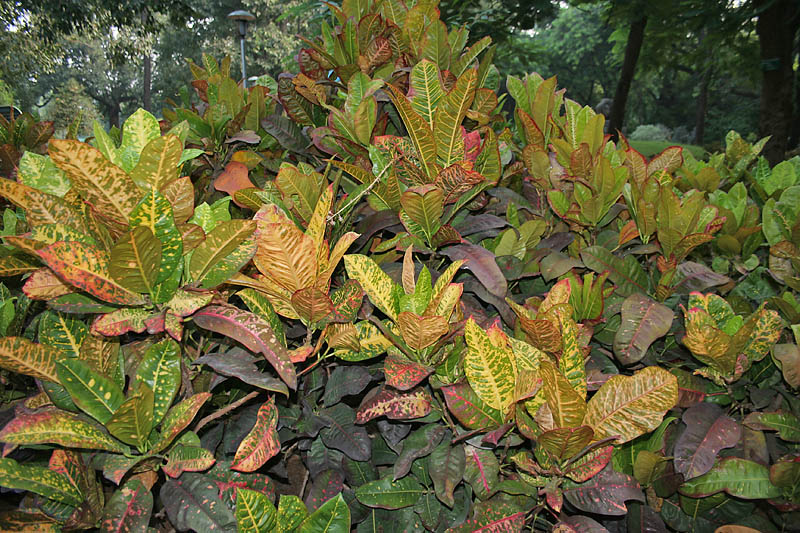
Codiaeum variegatum is an evergreen shrub in the spurge family reaching 6-10 feet (1.8-3 m) outdoors in frost-free climates and 2-4 feet (60-120 cm) as a container plant indoors. Leaves are alternate, leathery and glossy, 4-12 inches (10-30 cm) long, and range between cultivars from linear blades 0.5 inch (1.3 cm) wide to broadly ovate, oak-lobed, spirally twisted, or interrupted so a bare length of midrib links two separate blade sections. Leaf colour combines green, yellow, orange, red, pink, purple and near-black, frequently on a single leaf, and develops under strong light; plants held in low light push new leaves that stay plain green. Flowers are cream and 0.2-0.3 inch (5-8 mm) across on racemes 6-12 inches (15-30 cm) long, with male and female flowers carried on separate racemes on the same plant. Cut stems and leaves release a milky latex that irritates skin and causes vomiting and mouth pain when any part is swallowed by people or pets. Leaves drop within days of exposure below 50F (10C), a cold draught, or a dried-out root ball, and regrowth comes only from the nodes that remain.
Native Range
Codiaeum variegatum is native to the Maluku Islands and New Guinea, extending through Indonesia into northern Australia and the western Pacific islands. Across that range it grows in open lowland forest and along forest margins below 3,300 feet (1,000 m). Named selections run into the hundreds and are grown outdoors through USDA zones 10-11 and under glass or indoors elsewhere.Suggested Uses
Grown as a container plant in 8-12 inch (20-30 cm) pots in bright rooms and conservatories, and as a hedge or massed shrub in USDA zones 10-11 at 3-4 foot (90-120 cm) spacing. Compact cultivars 12-24 inches (30-60 cm) tall are used in summer bedding and patio containers in temperate regions and moved under cover before frost. Cut stems are used in tropical floral work, where the leaves hold 7-10 days in water.How to Identify
Appearance
Size & Dimensions
Height2' - 10'
Width/Spread2' - 6'
Bloom Information
Flowering is infrequent indoors and occurs mainly on outdoor plants in frost-free climates, chiefly from spring into early summer. Racemes 6-12 inches (15-30 cm) long carry cream flowers 0.2-0.3 inch (5-8 mm) across, with many stamens on male racemes and no petals on female racemes. Fruit is a three-lobed capsule about 0.4 inch (9 mm) across holding three seeds. The racemes are often cut off as they form, which holds growth in the foliage.
Detailed Descriptions
Foliage Description
green, yellow, orange, red, pink, purple and near-black, often combined on one leafGrowing Conditions
Sun Requirements
Requires 4-8 hours of direct sunlight daily
• Full Sun: 6+ hours of direct sunlight
• Partial Shade: 3-6 hours of direct sunlight
• Full Shade: Less than 3 hours of direct sunlight
Care & Maintenance
Care Guide
Grows in bright light, taking 4-6 hours of direct morning sun indoors or full sun in the tropics, since leaf colour fades towards green under low light. Indoor plants hold at 60-85F (16-29C) with humidity above 40 percent, positioned clear of doorways and heating vents where cold draughts bring on leaf drop. Potting medium is a free-draining peat or coir mix with added bark or perlite, held evenly moist through spring and summer and allowed to dry in the top 1 inch (2.5 cm) between waterings in winter. Feeding runs to a balanced liquid fertiliser every 4-6 weeks from March to September and stops over winter. Spider mites, mealybugs and scale build up on indoor plants in dry air, showing first as stippling or sticky residue on the leaf undersides. Repotting into a container 2 inches (5 cm) wider happens every 2-3 years in spring, and the latex released at every cut stains fabric and irritates skin.Pruning
Stems are shortened in spring to a node, taking up to a third of the plant height, and new shoots break within 3-4 weeks from the nodes below each cut. Plants that have shed their lower leaves are cut to 6-12 inches (15-30 cm) above the pot rim, which returns branching to the base. Cut surfaces bleed latex that stops flowing within a few minutes and calls for no sealing compound.Pruning Schedule
Prune: March–April
early spring
Container Growing
Suitable for container growing
Minimum container size: 3 gallons