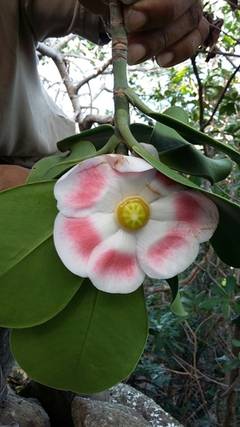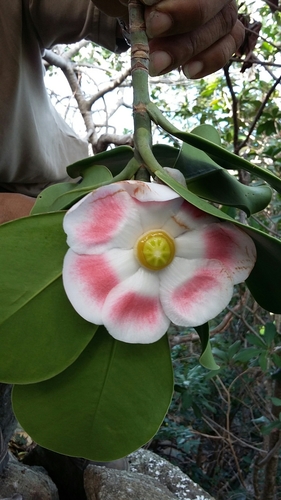
Clusia, Genus, spp., Multiple species,
- Genus
- Multiple species
attorney trees
Neotropics (southern Florida, Caribbean, Mexico, Central and South America)
Overview
Clusia is a genus of roughly 300 to 400 evergreen trees and shrubs in the family Clusiaceae, distributed across the Neotropics from southern Florida and the Caribbean through Mexico, Central America, and tropical South America. Plants range from 3 to 65 ft (1 to 20 m) tall depending on species and growth form. Many species begin life as hemiepiphytes, germinating in the canopy of a host tree and sending aerial roots to the ground; some, such as C. rosea, can encircle and overtop the host. Leaves are opposite, thick, and leathery, 2 to 8 in (5 to 20 cm) long, paddle-shaped in C. rosea and narrower in other species. Cut stems and foliage release a sticky yellow to white latex. Several species use crassulacean acid metabolism, fixing carbon at night, which supports growth on seasonally dry and nutrient-poor sites. Flowers are 1 to 3 in (2.5 to 8 cm) across with waxy white, cream, or pink petals, and most species are dioecious, carrying male and female flowers on separate plants. The fruit is a leathery capsule that splits to expose seeds in red to orange pulp. Limitations across the genus include frost sensitivity and, in C. rosea, vigorous aerial-root growth that can lift pavers and crack walls.
Native Range
Clusia is native to the Neotropics, ranging from southern Florida and the Bahamas through the Caribbean, Mexico, and Central America into tropical South America as far as Brazil and the Andes. The genus reaches its greatest diversity in the rainforests and montane forests of northern South America. Several species occur in coastal scrub and on limestone outcrops.Suggested Uses
Clusia species are grown as hedges, privacy screens, and specimen trees in frost-free regions, and C. rosea is kept as a container and indoor plant in cooler climates. Salt-tolerant species are planted in seaside gardens. Within their native range, several species serve as canopy or understory trees in restoration plantings.How to Identify
Appearance
Size & Dimensions
Height3' - 65'
Width/Spread3' - 30'
Bloom Information
Flowering varies across the genus and its tropical range, with many species blooming intermittently through the warm months and some flowering year-round in equatorial climates. In C. rosea, flowers open at night and persist into the following day. Individual plants bear either male or female flowers, so fruit forms only where both sexes grow near one another.
Detailed Descriptions
Flower Description
white to pinkFoliage Description
dark green to blue-greenGrowing Conditions
Sun Requirements
Requires 6-10 hours of direct sunlight daily
• Full Sun: 6+ hours of direct sunlight
• Partial Shade: 3-6 hours of direct sunlight
• Full Shade: Less than 3 hours of direct sunlight
Care & Maintenance
Care Guide
Most Clusia species grow in full sun to partial shade and tolerate a range of soils, including sandy and limestone substrates, where drainage is good. Established plants are drought tolerant, and the CAM species in particular withstand extended dry spells. They are sensitive to frost, with most species injured below 30 to 32 F (-1 to 0 C). Water needs are low to moderate once roots establish, and salt tolerance in coastal species such as C. rosea permits growth near the shore. Soil pH from about 6.0 to 7.5 suits most species. Growth is slow to moderate, and aerial roots spread along walls and adjacent plantings where they are left uncut.Pruning
Clusia tolerates hard pruning and is frequently sheared as a hedge or screen in tropical and subtropical landscapes. Cutting the stems releases latex, which is sticky and stains tools and clothing. Pruning during the warm season, after the main flush of growth, limits stress on the plant.Container Growing
Suitable for container growing