Clethra, Genus, alnifolia, Species,
- Genus & species
summersweet, sweet pepperbush
Eastern United States from Maine south to Florida and west to Texas; swamps, bogs, wet woodlands, and stream banks
Overview
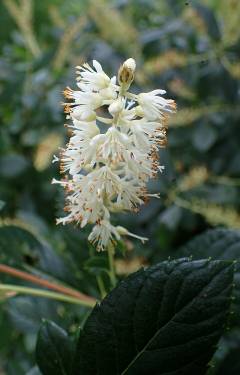
Clethra alnifolia is an upright deciduous shrub reaching 4–8 feet (1.2–2.4 m) tall and 4–6 feet (1.2–1.8 m) wide, suckering from the base to form a multi-stemmed colony. Leaves are obovate, 2–4 inches (5–10 cm) long, dark green with serrated margins, turning yellow to gold in fall. Tiny flowers are carried in erect bottlebrush-like terminal racemes 3–6 inches (7–15 cm) long in July and August on current-season wood; flower color is white in the species and pink in selected cultivars including 'Ruby Spice' and 'Pink Spire'. The flowers are strongly fragrant with a sweet, spicy scent that carries 20–30 feet (6–9 m) on still warm evenings, and they draw bees, butterflies, and hummingbirds across a 4-week bloom period. The species blooms reliably in shaded sites where most native flowering shrubs do not bloom heavily, which extends garden color into midsummer in shade plantings. Common cultivars include 'Hummingbird' (compact, 3–4 feet / 90–120 cm), 'Ruby Spice' (pink racemes), and 'Sixteen Candles' (upright). Limitation: the species requires consistently moist to wet acidic soil at pH 4.5–6.0 and develops iron chlorosis (yellowing) in alkaline soils above pH 6.5; it does not tolerate drought, and the suckering habit forms a spreading thicket without periodic removal of basal suckers.
Native Range
Native to the eastern United States from Maine south to Florida and west to Texas, growing in swamps, bogs, wet woodlands, and along stream banks in consistently moist to wet acidic soils.Suggested Uses
Used in rain gardens, wet sites, stream banks, bog gardens, woodland edges, and shaded mixed borders at 4–6 foot (1.2–1.8 m) spacing. Container culture is possible in pots of at least 5 gallons (19 L) with consistent moisture. The strongly fragrant midsummer bloom carries through the surrounding garden on still evenings and supplies nectar for butterflies and hummingbirds. Dry sites and alkaline soils are unsuitable.How to Identify
Appearance
Size & Dimensions
Height4' - 8'
Width/Spread4' - 6'
Bloom Information
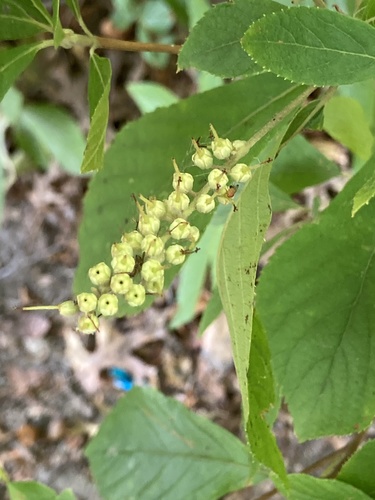
Tiny strongly fragrant flowers in erect bottlebrush-like terminal racemes 3–6 inches (7–15 cm) long open from July through August on current-season wood, lasting about 4 weeks. Flower color is white in the species and pink in cultivars such as 'Ruby Spice' and 'Pink Spire'. Small brown capsules persist on the upright raceme stalks into fall and winter.
Detailed Descriptions
Flower Description
white or pink (varies by cultivar); tiny, in erect bottlebrush-like racemes 3-6 inches (7-15 cm) long; strongly fragrant with a sweet, spicy scentFoliage Description
dark green; obovate, 2-4 inches (5-10 cm) long, with serrated margins; turns yellow to gold in fallGrowing Conditions
Sun Requirements
Requires 2-8 hours of direct sunlight daily
• Full Sun: 6+ hours of direct sunlight
• Partial Shade: 3-6 hours of direct sunlight
• Full Shade: Less than 3 hours of direct sunlight
Care & Maintenance
Care Guide
Site in part shade to full sun with 2–8 hours of direct sun per day in moist to wet acidic soil with a pH of 4.5–6.0. The species blooms reliably in full shade, which extends use into shaded garden positions where many flowering shrubs do not flower heavily. Soil moisture should remain consistent through the growing season; the species does not tolerate drought. Iron chlorosis develops in alkaline soils above pH 6.5. Bloom occurs on current-season wood, so corrective pruning is done in early spring (March) before new growth emerges. Hardy in USDA zones 3–9. Routine fertilization is not required in soils with adequate organic matter.Pruning
Pruning is done in early spring (March) before new growth emerges because the shrub blooms on current-season wood. Renewal pruning consists of cutting the oldest stems to the base each year to thin the colony and stimulate vigorous new flowering stems. Suckers from the base can be cut at the soil line to limit thicket spread.Pruning Schedule
Prune: March
early spring
Container Growing
Suitable for container growing
Minimum container size: 5 gallons