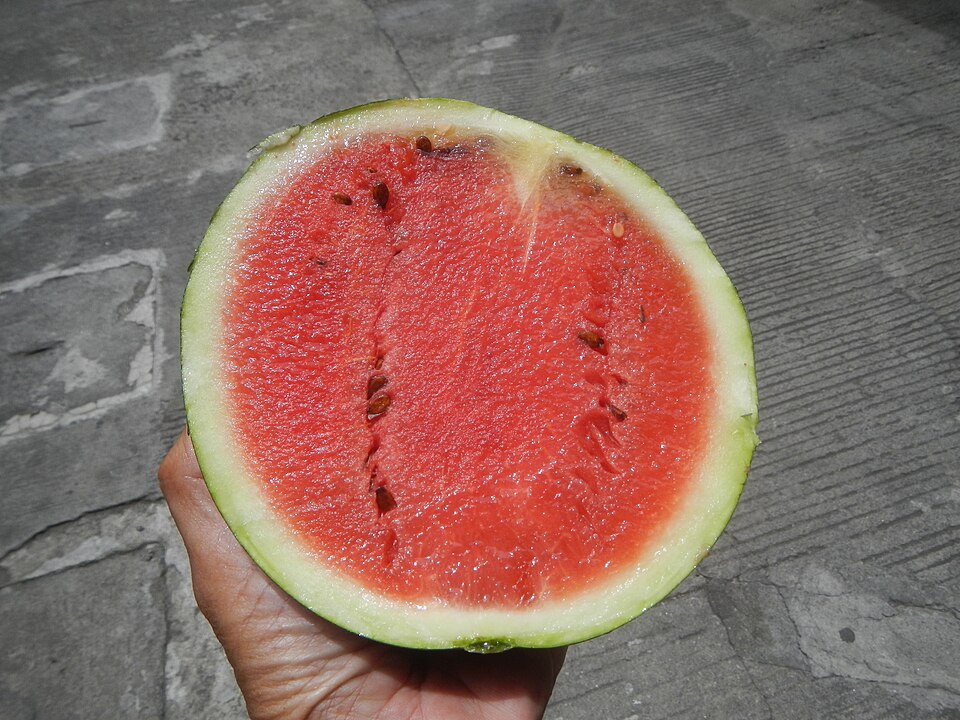
Citrullus, Genus, lanatus, Species, 'Sugar Baby', Cultivar,
- Genus & species
- Cultivar
sugar baby watermelon
Tropical and subtropical Africa; the parent species C. lanatus has been cultivated for over 4,000 years with origins in the Kalahari and northeastern Africa.
Overview
Citrullus lanatus Sugar Baby is an annual vining cucurbit in the gourd family (Cucurbitaceae) reaching 12-15 inches (30-38 cm) tall with a 48-72 inch (120-180 cm) trailing vine spread, more compact than full-size watermelons. The cultivar was developed by M. Hardin of Conley, Georgia and introduced in 1956 as an icebox-type watermelon, sized for refrigerator storage rather than for sliced summer-picnic distribution. Fruit is round, 6-12 pounds (2.7-5.4 kg), with a solid dark green rind that lacks the classical light-and-dark striping of larger picnic types, and the rind is thin but tough. Flesh is deep red and sweet with a smooth-grained texture. Days-to-maturity is 70-80 from transplant, which positions Sugar Baby as one of the earlier-ripening watermelons among home-garden cultivars and which makes it suitable for short-season Pacific Northwest summers where larger watermelons rarely ripen before fall. Open-pollinated, so seed saved from ripe fruit reproduces true to the parent. Vines are monoecious (male and female flowers on the same plant), with male flowers opening 7-10 days before the first female flowers, and bee pollination is required for fruit set; each pollinated female flower produces one fruit, and limiting each vine to 3-4 developing fruits concentrates plant resources for full size and sweetness on the retained fruit. Hardy as a tender annual in USDA zones 5-10 only during the frost-free growing season; elsewhere grown from indoor starts.
Native Range
Citrullus lanatus is native to tropical and subtropical Africa, with the wild ancestor populations centered in the Kalahari basin and northeastern Africa, where the species has been cultivated for over 4,000 years; the desert melon (C. lanatus var. citroides) and the cultivated sweet watermelon represent diverged lineages within the species. Sugar Baby is an open-pollinated cultivar developed by M. Hardin of Conley, Georgia, introduced in 1956, and selected for compact vines and small refrigerator-sized fruit suitable for home gardens.Suggested Uses
Grown in vegetable gardens, raised beds, and large containers of 10 gallons (38 liters) or larger for icebox-type watermelon harvest. The compact 4-6 foot vine spread suits smaller home gardens where standard 8-12 foot vines would not fit. The 70-80 day maturity window allows production in Pacific Northwest lowland gardens where longer-season watermelon cultivars rarely ripen before frost. Fruit is used for fresh eating, fruit salads, agua fresca, and pickled rind. Open-pollinated status allows seed saving from ripe fruit. The cultivar is included in heirloom watermelon trials and Seed Savers Exchange grow-outs alongside other open-pollinated icebox types.How to Identify
Appearance
Size & Dimensions
Height1' - 1'3"
Width/Spread4' - 6'
Bloom Information
Small yellow flowers open from June through August, with male flowers opening 7-10 days before the first female flowers as is typical of monoecious cucurbits. Each flower opens for one day only and bee pollination during that single-day window is required for fruit set; in the absence of bee activity, hand-pollination by transferring pollen from male to female flowers with a small brush early in the morning produces fruit set. Fruit develops 35-45 days after pollination and ripens 70-80 days after transplant in Pacific Northwest lowland gardens.
Detailed Descriptions
Flower Description
Yellow; small monoecious flowers with male and female flowers on the same plant; bee-pollinated through the flowering windowFoliage Description
Dark green; deeply lobed and palmate, characteristic of the Cucurbitaceae family; carried on compact trailing vinesGrowing Conditions
Sun Requirements
Requires 8-12 hours of direct sunlight daily
• Full Sun: 6+ hours of direct sunlight
• Partial Shade: 3-6 hours of direct sunlight
• Full Shade: Less than 3 hours of direct sunlight
Care & Maintenance
Care Guide
Plants require full sun (8 or more hours of direct daily light) and rich well-drained sandy loam at pH 6.0-7.0. Seeds are started indoors 3-4 weeks before the last frost date in 4-inch peat pots that transplant without root disturbance, since cucurbits resent root disruption, or direct-sown after soil temperature reaches 70°F (21°C). Hills or mounds of amended compost-rich soil concentrate root zone heat and improve drainage compared to flat ground. Plants are heavy feeders; consistent moisture is maintained through fruit set, then watering is reduced during the final 10-14 days of ripening to concentrate sugars in the flesh. Vines are limited to 3-4 fruits each by removing additional fruit at golf-ball stage, which directs plant resources toward full-size and full-sweetness development on the retained fruit. Ripeness is judged by two field tests: the belly spot (the underside in contact with the ground) turns from white to creamy yellow at full ripeness, and the rind resists fingernail scratch on a ripe fruit.Pruning
No pruning is applied to vines. Fruit thinning to 3-4 developing fruits per vine at golf-ball stage is the standard production practice, and removed immature fruit can be eaten as a substitute for cucumber.Container Growing
Suitable for container growing
Minimum container size: 10 gallons
Toxicity
Non-toxicPlanting Guide
Planting Methods & Timing
Planting Method
both
Indoor Start
4 weeks before last frost
Direct Sow Timing
Direct-sow after soil temperature reaches 70°F (21°C) and all frost risk has passed; in Pacific Northwest lowland gardens, this is typically late May through mid-June.
Days to Maturity
70–80 days
Plant Spacing
36 inches
Companion Planting
Good Companions
Avoid Planting With