Overview
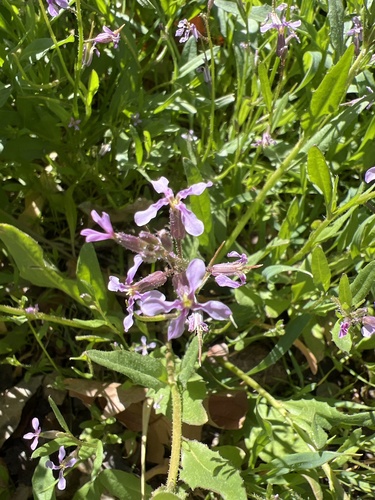
Chorispora tenella is a low annual or winter annual in the mustard family (Brassicaceae), 4–16 inches (10–40 cm) tall, with branched stems covered in sticky glandular hairs that give off a musky, unpleasant smell. The leaves are oblong with wavy or shallowly lobed margins, mostly in a loose basal rosette with a few smaller stem leaves. In early spring it opens four-petaled flowers of pale purple to lavender, about 0.4–0.5 inch (10–13 mm) across, among the earliest mustards to bloom. The seedpods are slender and curved, 1–1.6 inches (2.5–4 cm) long, ending in a long beak, and break crosswise into one-seeded segments rather than splitting lengthwise. Native to central and southwestern Asia, it has spread across much of western and central North America as a weed of wheat fields, alfalfa, rangeland, roadsides, and gardens. When dairy cattle graze it, the musky compounds can taint milk. It germinates in fall, overwinters as a rosette, and matures early, so it sets seed before many crops close in.
Native Range
Chorispora tenella is native to central and southwestern Asia, including parts of Russia, the Caucasus, and Central Asia. It has naturalized widely across western and central North America and is treated there as an agricultural and roadside weed.Suggested Uses
Chorispora tenella has no horticultural use and is managed as a weed across western and central North America. Where it occurs in cropland and pasture, it is controlled to protect yields and to keep its musky compounds out of dairy milk. It is included in regional weed-management programs.How to Identify
Appearance
Size & Dimensions
Height4" - 1'4"
Width/Spread4" - 1'
Bloom Information
Pale purple flowers open in early spring, often from March into May, earlier than most weedy mustards. Bloom on a plant runs about 6 weeks as it branches and extends. The beaked, jointed pods form quickly and ripen as the plant dries in late spring.
Detailed Descriptions
Flower Description
pale purple to lavenderFoliage Description
greenGrowing Conditions
Sun Requirements
Requires 6-12 hours of direct sunlight daily
• Full Sun: 6+ hours of direct sunlight
• Partial Shade: 3-6 hours of direct sunlight
• Full Shade: Less than 3 hours of direct sunlight
Water & Climate
Water Needs
Drought Tolerance
Drought tolerant when established