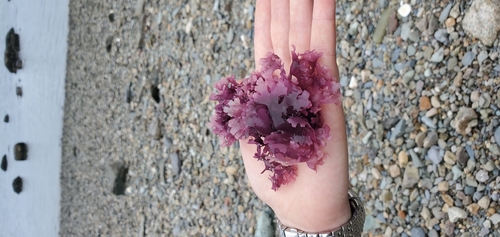
Chondrus, Genus, spp., Multiple species,
- Genus
- Multiple species
Irish moss
North Atlantic and North Pacific coasts
WaterHigh
Overview
Chondrus is a genus of marine red algae in the family Gigartinaceae, comprising roughly 10 species distributed across cold and cool-temperate coastal waters of the North Atlantic and North Pacific. Plants form flattened, repeatedly branching fronds 2-8 inches (5-20 cm) tall that attach to rock by a small disc-shaped holdfast in the lower intertidal and shallow subtidal zones. The fronds divide into fan-shaped segments and range from greenish-yellow to dark purplish-red, often showing a blue-green iridescence underwater. C. crispus, harvested commercially along Atlantic shores of Europe and northeastern North America, yields carrageenan, a gelling compound drawn from its cell walls. As a red alga, Chondrus has no true roots, stems, leaves, or flowers; it reproduces by spores rather than seed, alternating between spore-bearing and gamete-bearing generations that look alike. Growth occurs where wave action keeps water oxygenated and salinity near full-strength seawater. Populations thin on shores exposed to prolonged freshwater runoff or heavy sediment, both of which cut the light reaching the fronds.
Native Range
Chondrus occurs on rocky shores of the North Atlantic, from the British Isles and continental Europe to the Canadian Maritimes and New England, with additional species in the cold waters of the northwestern Pacific around Japan and Korea. It grows in the lower intertidal and shallow subtidal zones where rock forms a firm anchor.Suggested Uses
Chondrus, particularly C. crispus, is harvested as a source of carrageenan used to thicken foods and is eaten in traditional dishes such as blancmange and carrageen pudding. In cold-water marine aquaria it is grown attached to rock. Wild stands stabilise intertidal rock surfaces and shelter small invertebrates.How to Identify
Appearance
Size & Dimensions
Height2" - 8"
Width/Spread2" - 6"
Growing Conditions
Water & Climate
Water Needs
