Chionodoxa, Genus, luciliae, Species,
- Genus & species
glory of the snow
Western Turkey (Bozdağ range near Izmir)
Overview
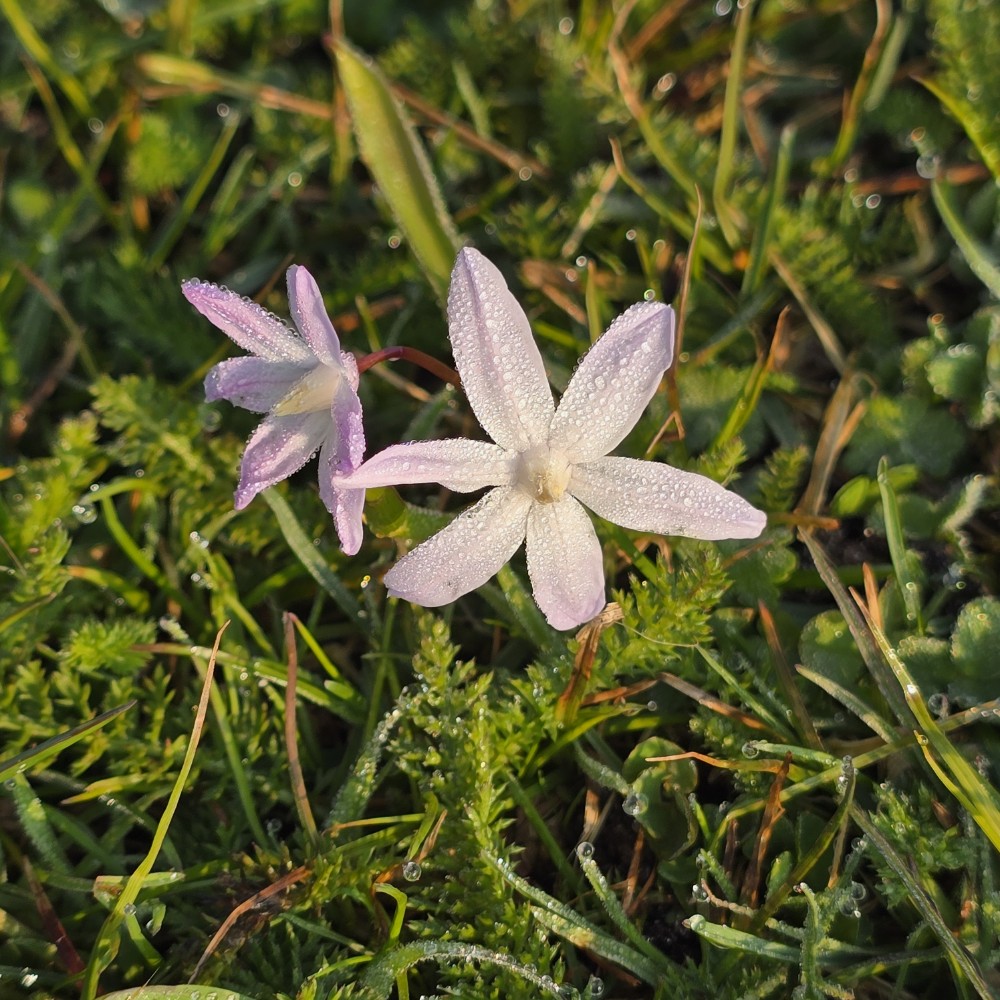
Chionodoxa luciliae (now often reclassified by taxonomists as Scilla luciliae) is a small, spring-blooming, bulbous perennial reaching 4–6 inches (10–15 cm) tall with a spread of 2–3 inches (5–8 cm) per bulb. The plant carries star-shaped, upward-facing flowers 0.75–1 inch (2–2.5 cm) across with blue petals fading to a white center, carried 1–3 per stem. Two to three narrow, strap-like, basal leaves 3–6 inches (8–15 cm) long accompany each flowering stem. Bloom occurs in March–April, often pushing through the last snow in cooler regions—the source of the common name. The bulbs naturalize freely by self-sowing and by offset bulblet production, forming expanding drifts that double in coverage every 3–5 years under suitable conditions. The foliage dies down by late May, leaving no trace above ground during summer, fall, and winter. Growth rate is moderate; colonies expand noticeably within 3–5 years from initial planting. The small stature limits visibility from a distance, and mass plantings of 25 or more bulbs are needed for impact. Squirrels and chipmunks sometimes dig newly planted bulbs, particularly in the first fall after planting; established colonies are generally left alone by rodents.
Native Range
Chionodoxa luciliae is native to western Turkey (mountains near Smyrna/Izmir, particularly the Bozdağ range), occurring in alpine and subalpine meadows, rocky slopes, and at the edge of melting snowfields from 5,000 to 7,500 feet (1,500–2,300 m).Suggested Uses
Planted in mass drifts of 25 or more bulbs in lawns, under deciduous trees, in rock gardens, and along woodland paths at 2–3 inch (5–8 cm) spacing. The early bloom fills the gap between snowdrops (Galanthus) and daffodils (Narcissus). Functions in naturalized lawns where mowing is delayed until June—the foliage completes its cycle before lawn mowing resumes. The small scale reads at close range along paths, at the base of walls, and in raised beds where the 4–6 inch flowers are at viewing height. Paired with Galanthus, Crocus, and Narcissus, the species extends a succession of early spring color from February through April. Grows in containers; 10–15 bulbs in a 6-inch (15 cm) pot produce a full display.How to Identify
Appearance
Size & Dimensions
Height4" - 6"
Width/Spread2" - 3"
Bloom Information
Star-shaped, upward-facing flowers 0.75–1 inch (2–2.5 cm) across with blue petals and white centers open 1–3 per stem from March through April. Bloom duration is 2–3 weeks. Flowers open fully in sun and partially close on overcast days, opening again when sun returns.
Detailed Descriptions
Flower Description
Blue with white centerFoliage Description
Narrow, strap-like, medium greenGrowing Conditions
Sun Requirements
Requires 4-10 hours of direct sunlight daily
• Full Sun: 6+ hours of direct sunlight
• Partial Shade: 3-6 hours of direct sunlight
• Full Shade: Less than 3 hours of direct sunlight
Care & Maintenance
Care Guide
Plant bulbs 3 inches (8 cm) deep and 2–3 inches (5–8 cm) apart in fall (September–October in zones 3–5; October–November in zones 6–8). Full sun to partial shade in average, well-drained soil. The early bloom occurs before deciduous tree canopies leaf out, so sites under deciduous trees receive adequate spring light. Foliage that yellows naturally after bloom (typically by late May) replenishes the bulb for the following year, so leaving the leaves intact until they yellow supports next-spring bloom. No fertilization needed once established. The bulbs are rodent-resistant after establishment; protective mesh over newly planted bulbs reduces fall digging by squirrels. Self-sows freely to form colonies.Pruning
No pruning required during the growing season. Foliage yellows naturally by late May and dies back without intervention. Removing or mowing green foliage before yellowing reduces bulb storage reserves and weakens future bloom; the leaves are left in place until they have completed their natural senescence.Container Growing
Suitable for container growing
Minimum container size: 1 gallons