Chilopsis, Genus, spp., Multiple species,
- Genus
- Multiple species
desert willow
Overview
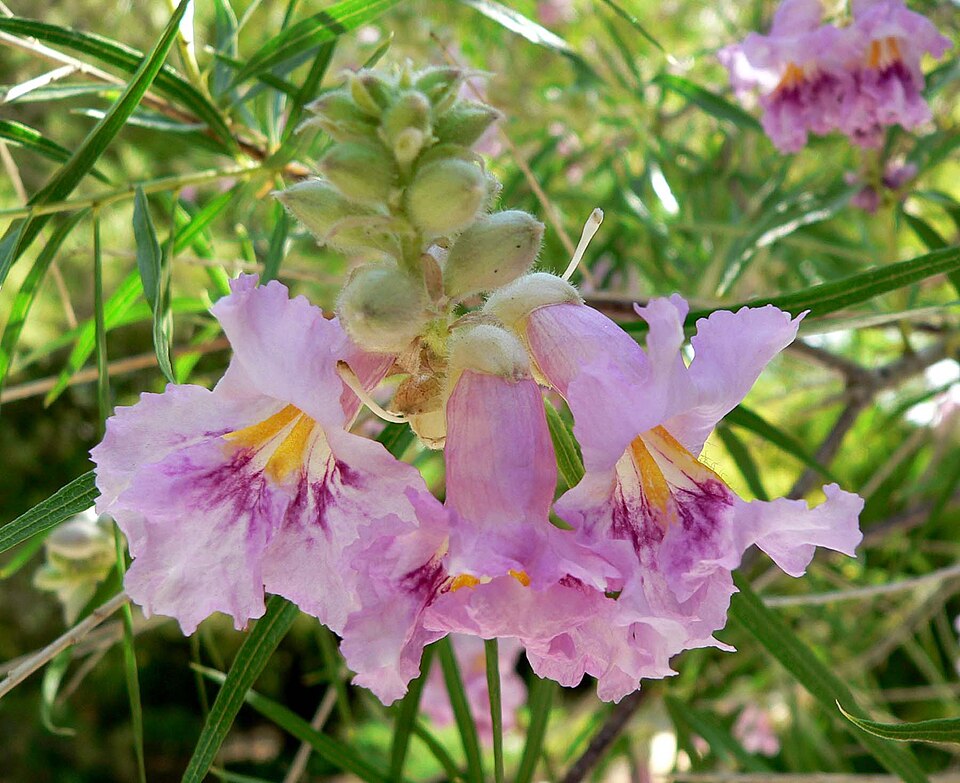
Chilopsis is a genus in the family Bignoniaceae containing a single species, C. linearis, the desert willow, native to the arid southwestern United States and northern Mexico. Despite the common name and its narrow, willow-like leaves, the genus is not related to true willows. Plants grow as large deciduous shrubs or small trees 10-30 feet (3-9 m) tall and 10-20 feet (3-6 m) wide, with an open, often multi-stemmed and somewhat irregular crown. The leaves are linear to lance-shaped, 4-12 inches (10-30 cm) long and less than half an inch (1 cm) wide, dropping in winter and during prolonged drought. From late spring through summer the branch tips carry clusters of trumpet-shaped flowers 1-1.5 inches (2.5-4 cm) long in white, pink, lavender, and burgundy, marked with purple lines and yellow in the throat, and lightly scented. Flowering is followed by slender bean-like seed capsules 4-12 inches (10-30 cm) long that persist into winter. The genus tolerates extreme drought once established and grows naturally in desert washes and along intermittent streams. One limitation is cold sensitivity: plants are damaged below about 10F (-12C) and are restricted to zones 7-9. The flowers draw hummingbirds and large bees.
Native Range
Chilopsis is native to the southwestern United States, including California, Nevada, Arizona, New Mexico, and Texas, and to northern Mexico. It grows in desert washes, arroyos, and along seasonal watercourses below about 5,000 feet (1,500 m).Suggested Uses
Used as a flowering specimen, screen, or small shade tree in desert and dry-climate gardens and in low-water landscapes. Planted along streets and in median strips in hot regions for its drought tolerance. Suited to wildlife and hummingbird gardens.How to Identify
Appearance
Size & Dimensions
Height10' - 30'
Width/Spread10' - 20'
Bloom Information
Flowering begins in late spring and continues in flushes through summer into early autumn, roughly May to September, often intensifying after rain. Individual flowers last a day or two, but the branch tips form new buds over many weeks. Bloom is heaviest on the current season's growth.
Detailed Descriptions
Flower Description
white, pink, lavender, and burgundy with yellow and purple throatFoliage Description
greenGrowing Conditions
Sun Requirements
Requires 6-12 hours of direct sunlight daily
• Full Sun: 6+ hours of direct sunlight
• Partial Shade: 3-6 hours of direct sunlight
• Full Shade: Less than 3 hours of direct sunlight
Care & Maintenance
Care Guide
Grow Chilopsis in full sun in light, sharply drained soil; sandy or rocky ground matches its desert origin. Once established it needs little or no supplemental water, though occasional deep soaking in summer extends flowering. Overwatering and heavy, poorly drained soils cause root problems and weak growth. Plants tolerate heat, wind, and alkaline soil but are damaged by hard frost. Feeding is seldom needed, and high nitrogen reduces bloom in favor of leafy growth. Flowers form on new wood, so plants bloom even after being cut back.Pruning
Pruning in late winter while dormant shapes the open crown, removes crossing stems, and can lift lower branches into a single- or multi-trunk tree form. Because flowers form on new growth, hard pruning does not sacrifice the coming season's bloom. Removing spent seed capsules can prolong flowering.Pruning Schedule
Prune: February
winter
