Centrosema, Genus, spp., Multiple species,
- Genus
- Multiple species
butterfly peas
Americas (southeastern USA to tropical South America)
Overview
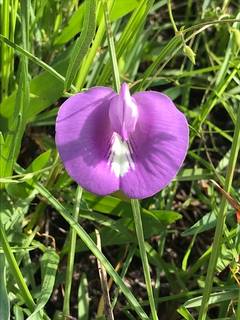
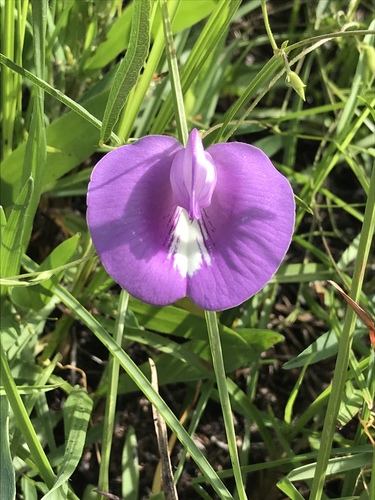
Centrosema is a genus of about 40 twining and trailing perennial legumes in the family Fabaceae, native to warm-temperate and tropical regions of the Americas. Most species are herbaceous to slightly woody-based vines that climb or scramble by twining stems to 3–13 ft (1–4 m), with some forming low mats where no support is present. The leaves are pinnately divided into three (rarely five to seven) leaflets that are oval to lance-shaped and 1–3 in (2.5–8 cm) long. From summer into autumn, pea-type flowers 1–2 in (2.5–5 cm) across open singly or in small clusters in shades of violet, lavender, pink, and white, marked with pale or greenish centres. The flowers are resupinate, held so that the large banner petal sits at the bottom, the trait that gives the butterfly-pea common name. Flat, linear seed pods 3–6 in (8–15 cm) long follow and split to scatter seeds. As nitrogen-fixing legumes, several species, including C. pubescens and C. molle, are grown across the tropics as pasture, cover, and green-manure crops, while C. virginianum of the southeastern United States grows in open woods and sandy ground. Frost kills top growth, and most species are limited to USDA zones 9–11.
Native Range
Centrosema is native to the Americas, from the southeastern and south-central United States through Mexico, Central America, the Caribbean, and much of tropical South America. The genus grows in open woodland, savanna, scrub, and disturbed sandy ground, and several forage species have been introduced to Africa, Asia, and Australia.Suggested Uses
Centrosema is grown on trellises, fences, and arbours as a flowering climber in warm climates and as groundcover on banks. In agriculture the tropical species serve as pasture legumes, cover crops, and green manure that enriches soil nitrogen. The native C. virginianum is planted in wildflower and pollinator gardens in the southeastern United States.How to Identify
Appearance
Size & Dimensions
Height3' - 13'
Width/Spread3' - 6'
Bloom Information
Flowering runs from early summer into autumn in temperate parts of the range and through much of the year in frost-free tropical climates. The pea-shaped flowers open a few at a time over a long season. Each flower lasts about a day, followed by the slender flattened pods.
Detailed Descriptions
Flower Description
violet, lavender, pink, and whiteFoliage Description
greenGrowing Conditions
Sun Requirements
Requires 6-12 hours of direct sunlight daily
• Full Sun: 6+ hours of direct sunlight
• Partial Shade: 3-6 hours of direct sunlight
• Full Shade: Less than 3 hours of direct sunlight
Care & Maintenance
Care Guide
Centrosema grows in full sun to light shade and well-drained sandy or loamy soil, tolerating poor, acidic ground because the roots fix their own nitrogen. Established plants withstand heat and drought, though flowering and growth are stronger with occasional moisture. The twining species need a trellis, fence, or neighbouring plants to climb, or they spread as groundcover. Most species are frost-tender and grow as perennials only in zones 9–11, behaving as annuals or dying back where winters are cold. Propagation is by scarified seed, which germinates readily in warm soil. The forage species tolerate grazing and cutting and regrow from the base.Pruning
Pruning is limited to cutting back overlong or tangled stems during the growing season to control spread. Frost-damaged top growth is removed in spring, when plants regrow from the rootstock in mild zones. Shearing forage stands promotes dense basal regrowth.Pruning Schedule
Prune: March–April
early spring
Container Growing
Suitable for container growing
Minimum container size: 3 gallons