Overview
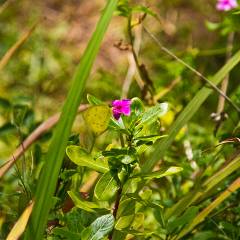
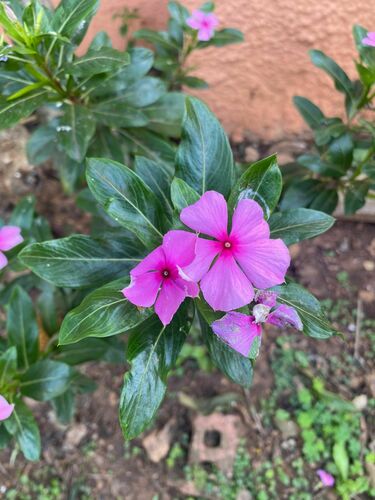
Catharanthus roseus is a tender evergreen perennial typically grown as a warm-season annual outside USDA zones 9-11, reaching 6-18 inches (15-45 cm) tall and 12-24 inches (30-60 cm) wide. Stems are upright to spreading, branching freely from the base, with opposite glossy dark-green oblong leaves 1-3 inches (2.5-7.5 cm) long and a prominent pale midrib. Flowers are flat, five-petaled, 1-2 inches (2.5-5 cm) across, in shades of white, pink, magenta, red, lavender, and purple, often with contrasting central eyes. Bloom continues from late spring until first frost (16-20 weeks of continuous flowering in zones 5-8). Plants tolerate heat and drought once established and require minimal deadheading. The species contains over 70 alkaloids including vinblastine and vincristine, both used in chemotherapy; all parts are toxic to humans and pets if ingested, causing vomiting, hypotension, and central nervous system effects. Self-sown seedlings can naturalize in zones 9-11. Common pests include aphids, whitefly, and root rot from poor drainage. Modern hybrid series like 'Cora' and 'Pacifica' show improved disease resistance over older cultivars and tolerate cooler night temperatures.
Native Range
Catharanthus roseus is native to Madagascar, where it grows in coastal scrub and rocky habitats. The species has naturalized widely in tropical and subtropical regions including the Caribbean, southern United States, and tropical Africa. In its native range, populations are now considered endangered due to habitat loss, while cultivated forms are produced commercially worldwide.Suggested Uses
Catharanthus roseus is used in summer annual beds, container plantings, and edging along walks, spaced 8-12 inches (20-30 cm) apart for solid coverage. The compact cultivars suit hanging baskets and window boxes of 1+ gallon (4+ L) volume. Plants are used in heat-tolerant urban plantings, including median strips and parking islands where many other annuals decline.How to Identify
Appearance
Size & Dimensions
Height6" - 1'6"
Width/Spread1' - 2'
Bloom Information
Bloom begins 6-8 weeks after planting nursery starts, typically late May in USDA zones 5-7, and continues through first frost (16-20 weeks). Individual flowers last 3-5 days, with continuous replacement keeping the plant in steady color through summer heat. Hot weather above 85°F (29°C) accelerates flower turnover but does not pause flowering.
Detailed Descriptions
Flower Description
White, pink, magenta, red, lavender, purple, often with contrasting eyeFoliage Description
Glossy dark green with pale midribGrowing Conditions
Sun Requirements
Requires 6-12 hours of direct sunlight daily
• Full Sun: 6+ hours of direct sunlight
• Partial Shade: 3-6 hours of direct sunlight
• Full Shade: Less than 3 hours of direct sunlight
Water & Climate
Water Needs
Drought Tolerance
Drought tolerant when established
Care & Maintenance
Care Guide
Catharanthus roseus grows in full sun (6+ hours daily); shade reduces flowering by 50% and increases susceptibility to root rot. Soil should be well-drained sandy loam with pH 5.5-6.8; alkaline soils above pH 7.5 cause iron chlorosis. Watering is needed only when the top 1 inch (2.5 cm) of soil dries; overwatering causes Phytophthora and Pythium root rot. Soil temperature must reach 65°F (18°C) before transplanting; cold soils stunt plants permanently. Fertilization with a half-strength balanced liquid feed every 4-6 weeks supports steady bloom; high nitrogen suppresses flowering. Plants tolerate temperatures from 60-95°F (15-35°C) and survive light frost in zones 9-11.Pruning
Light pinching at planting and again at 4-6 weeks produces a fuller habit. Deadheading is generally unnecessary, since the plant is self-cleaning and spent flowers drop without setting visible seed. Stems can be sheared back by one-third in midsummer to remove leggy growth and stimulate new flowering shoots.Container Growing
Suitable for container growing
Minimum container size: 1 gallons