Castanopsis, Genus, cuspidata, Species,
- Genus & species
Japanese chinquapin
Japan (Honshu, Shikoku, Kyushu, Ryukyu Islands), southern Korea, southeastern China; warm-temperate evergreen broadleaf (laurel) forests from sea level to 2,500 feet / 750 m
Overview
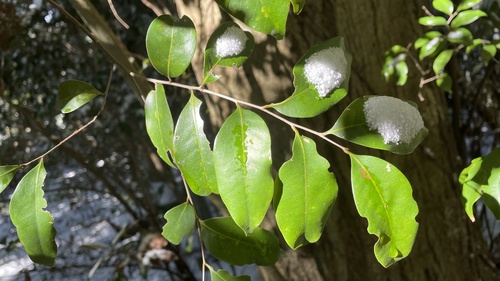
Castanopsis cuspidata is a medium to large densely branched broadleaf evergreen tree in the beech family (Fagaceae) reaching 30–50 feet (9–15 m) tall with a spread of 20–35 feet (6–10.5 m) in cultivation; in native habitat the species exceeds 80 feet (24 m). The crown is broadly pyramidal to rounded with dense layered branching. Alternate narrowly elliptic to lanceolate leaves 2–4 inches (5–10 cm) long and 0.5–1.5 inches (1.3–4 cm) wide are leathery, glossy dark green above, and silvery to golden-brown tomentose beneath; wind action flips the leaves and exposes the silvery-golden underside tone intermittently across the canopy. New growth emerges bronzy to copper-toned and contrasts with the mature dark green foliage. Bark is gray-brown and smooth on young trees, developing shallow fissures with age. Small erect creamy-white catkin-like flower spikes 2–4 inches (5–10 cm) long open in May–June and carry a strong musky fragrance that some find unpleasant at close range. Small rounded acorn-like nuts 0.5–0.7 inch (1.3–1.8 cm) enclosed in spiny cupules ripen in the second year after flowering. Growth rate is slow to moderate at 6–12 inches (15–30 cm) per year. Hardy to zone 7. Cold hardiness is limited, as sustained temperatures below 10°F (−12°C) damage the foliage and shoots. The species is a dominant canopy tree in the warm-temperate broadleaf evergreen (laurel) forests of Japan.
Native Range
Castanopsis cuspidata is native to Japan (Honshu, Shikoku, Kyushu, and the Ryukyu Islands), southern Korea, and parts of southeastern China, where it grows from sea level to 2,500 feet (750 m). In Japan the species is a dominant canopy tree of the warm-temperate evergreen broadleaf forests (laurel forests) and dominates ridge and slope communities on acidic soils.Suggested Uses
Grown as an evergreen shade tree, specimen, or screen in mild climates at 15–25 foot (4.5–7.5 m) spacing. The dense broadleaf evergreen canopy functions as year-round screening and shade, filling a role similar to mature holly or Magnolia grandiflora but with a silvery-golden leaf-underside effect visible as leaves flutter in wind — a feature characteristic of Castanopsis not matched by either comparison species. Woodland plantings and maritime-climate windbreak use are alternative roles. The glossy upper leaf surface with silvery undersides adds textural interest. In zones 7–8, a sheltered courtyard position or wall-trained form extends the range. Container culture is not suitable at tree size. Ecological significance as a dominant Japanese forest tree adds educational value in arboretum and botanical-collection plantings.How to Identify
Appearance
Size & Dimensions
Height30' - 50'
Width/Spread20' - 35'
Bloom Information
Erect creamy-white catkin-like flower spikes 2–4 inches (5–10 cm) long open in May–June and carry a strong musky fragrance that some garden visitors find unpleasant at close range. Flowering lasts 2–3 weeks. Small acorn-like nuts enclosed in spiny cupules ripen in the second year after flowering and drop in fall.
Detailed Descriptions
Flower Description
Creamy-white, erect catkin-like spikes 2-4 inches long with strong musky fragranceFoliage Description
Glossy dark green above with silvery to golden-brown tomentose undersides, narrowly elliptic to lanceolate 2-4 inches; new growth bronzy-copperGrowing Conditions
Sun Requirements
Requires 4-10 hours of direct sunlight daily
• Full Sun: 6+ hours of direct sunlight
• Partial Shade: 3-6 hours of direct sunlight
• Full Shade: Less than 3 hours of direct sunlight
Care & Maintenance
Care Guide
Grows in full sun to partial shade in moist well-drained acidic to neutral soil at pH 5.0–7.0, tolerating loam. Hardy to zone 7. Light shade is tolerated well. In zones 7–8, shelter from cold drying winter winds is required; a sheltered courtyard, woodland edge, or south-facing wall reduces foliage damage. In zones 9–10, winter shelter is less critical and the tree can be used in exposed positions. Consistent soil moisture benefits establishment; once established, moderate drought is tolerated. The strong floral fragrance in May–June may be noticeable in small enclosed garden spaces and influences siting away from patios and seating areas. No serious pest or disease problems are reported in cultivation.Pruning
Prune in late winter to early spring (February–March). Remove dead, crossing, or damaged branches. The dense naturally layered branching requires minimal shaping. The species tolerates moderate formative pruning and can be clipped to maintain a smaller size or trained as a large evergreen hedge in mild climates. Hard rejuvenation pruning is not recommended.Pruning Schedule
Prune: February–March
winterearly spring