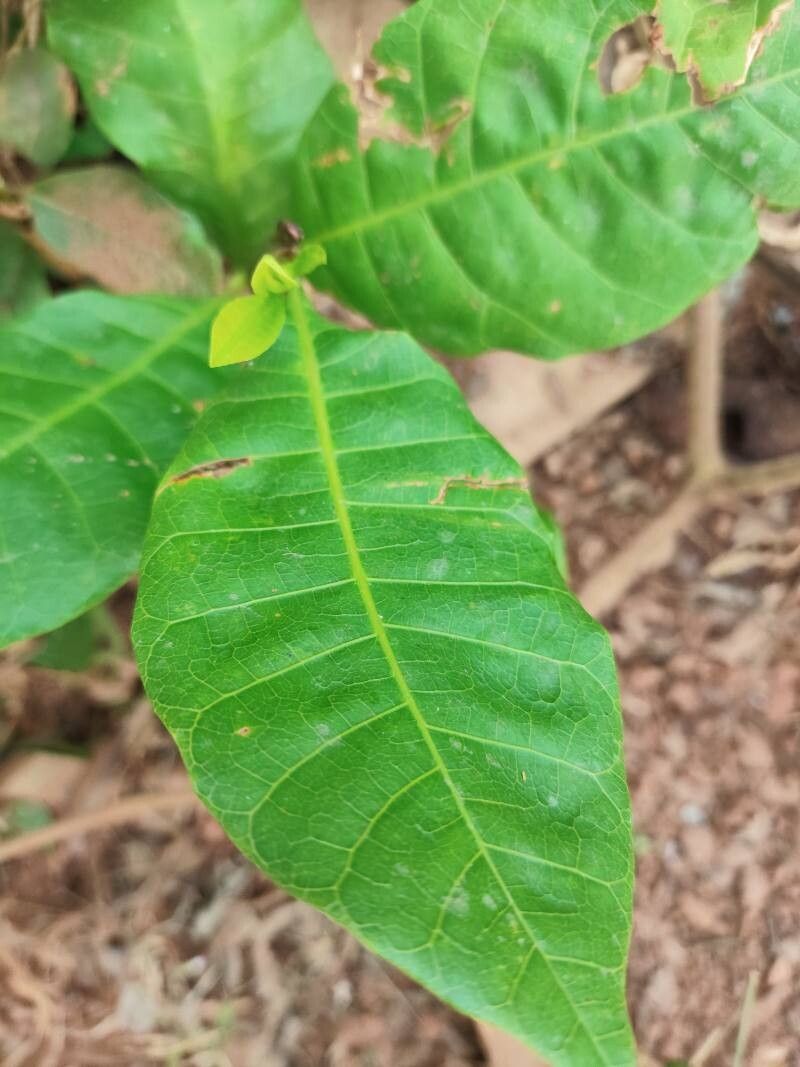
Anacardium, Genus, occidentale, Species,
- Genus & species
cashew
Overview
Anacardium occidentale is a tropical evergreen tree reaching 25-40 ft (7.5-12 m) tall and 30-40 ft (9-12 m) wide, with a low-branching spreading crown. Leathery oval-elliptic leaves 4-8 inches (10-20 cm) long and 2-4 inches (5-10 cm) wide, smooth-margined, dark green above and lighter beneath. Fragrant flowers in terminal panicles 4-10 inches (10-25 cm) long, with five pale pink-and-white petals turning red as they age; flowers borne in dry season. Each panicle produces several false fruits called cashew apples — fleshy red, yellow, or orange swollen pedicels 2-4 inches (5-10 cm) long with juicy astringent flesh. The true fruit is a kidney-shaped nut 1-1.5 inches (2.5-4 cm) long suspended below the cashew apple; the shell contains caustic phenolic oil (anacardic acid and cardol) that causes severe skin blistering on contact. The kernel inside requires roasting at 350-380°F (175-195°C) before consumption to drive off the shell oils. Begins bearing fruit at 3-5 years from planting, with full production at 8-10 years; productive lifespan 25-30 years. Frost-tender — foliage damage at 32°F (0°C); tree death below 28°F (−2°C). Native to northeastern Brazil, now cultivated commercially in India, Vietnam, Côte d'Ivoire, and Tanzania.
Native Range
The species A. occidentale is native to northeastern Brazil, particularly the coastal lowlands and inland savannas of Ceará, Piauí, and Rio Grande do Norte states. Grows in sandy and rocky soils at elevations from sea level to 3,000 ft (900 m). Naturalized across tropical Africa, India, and Southeast Asia following 16th-century Portuguese introduction.Suggested Uses
Grown commercially for nut production in tropical regions including India, Vietnam, Brazil, and West Africa, spaced 24-30 ft (7-9 m) apart in orchard rows. Planted as a shade tree and edge-of-yard fruit tree in zones 11-12 frost-free climates. Cashew apple is processed into juice, wine, and preserves in producing countries; nut processing requires industrial facilities due to the caustic shell oil.How to Identify
Appearance
Size & Dimensions
Height25' - 40'
Width/Spread30' - 40'
Bloom Information
Flowering occurs in dry season — December through April in the Northern Hemisphere range and June through October south of the equator. Individual panicles bloom for 2-3 weeks; total flowering period extends 6-10 weeks across a tree. Cashew apples and nuts ripen 60-90 days after pollination, with the false fruit changing from green to red, yellow, or orange. Self-fertile but cross-pollination by bees increases nut set.
Detailed Descriptions
Flower Description
Pale pink and white, fragrant, ageing redFoliage Description
Dark green above, lighter beneath, leathery oval-ellipticGrowing Conditions
Sun Requirements
Requires 6-10 hours of direct sunlight daily
• Full Sun: 6+ hours of direct sunlight
• Partial Shade: 3-6 hours of direct sunlight
• Full Shade: Less than 3 hours of direct sunlight
Care & Maintenance
Care Guide
Full sun (6+ hours) is required for fruit production; partial shade reduces yields by 40-60%. Tolerates a wide pH range from 4.5 to 7.5 in sandy, rocky, and well-drained loams; waterlogged soils cause root rot and tree decline. Established trees withstand 4-6 month dry seasons with deep root systems reaching 30-40 ft (9-12 m); irrigation during prolonged drought maintains nut size. Frost-tender — foliage damage at 32°F (0°C) and tree death below 28°F (−2°C) restrict cultivation to USDA zones 11-12 and frost-free tropical climates. Anthracnose (Colletotrichum gloeosporioides) causes flower and young fruit drop in humid conditions. Tea mosquito bug (Helopeltis antonii) is the main insect pest in Asian production regions, causing shoot dieback and fruit damage.Pruning
Prune to remove crossing branches and dead wood in the dry season after harvest. A single trunk is maintained by removing low suckers and water sprouts in the first 3-5 years. Heavy reductive pruning lowers nut yield for 1-2 seasons; trees regenerate from older wood. Limb breakage occurs during heavy fruit loads — selective thinning of overcrowded branches reduces structural failures.Pruning Schedule
Prune: May–June
late spring