Carnegiea, Genus, spp., Multiple species,
- Genus
- Multiple species
saguaro
Sonoran Desert of Arizona, northwestern Mexico, and southeastern California
Overview
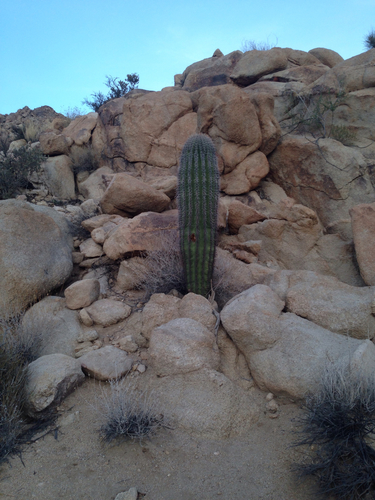
Carnegiea is a genus in the cactus family (Cactaceae) with a single species, the saguaro, Carnegiea gigantea, the giant columnar cactus of the Sonoran Desert. Mature plants form a thick, ribbed green column 15-50 feet (4.5-15 m) tall, usually with several upward-curving arms that appear only after 50 to 75 years of growth. The stem is lined with vertical ribs that expand like an accordion to store water after rain, and stout spines line each rib. Large waxy white flowers about 3 inches (8 cm) wide open at the stem tips from late spring into early summer, lasting a single night and the following morning. Bats, doves, and bees move pollen between them, and the flowers ripen into red fleshy fruit full of tiny black seeds. Growth is slow across a long life of 150 to 200 years, and seedlings depend on the shade of nurse shrubs to survive their first decades. Saguaros are protected under Arizona law and may not be taken from the wild without a permit. Frost, slow establishment, and a need for sharp drainage limit where the genus can grow.
Native Range
The saguaro is native to the Sonoran Desert of southern Arizona, the Mexican state of Sonora, and a small area of southeastern California. It grows on rocky slopes, bajadas, and desert flats below about 4,000 feet (1,200 m), where hard frost is brief and rare.Suggested Uses
The saguaro is grown as a living landmark in desert gardens and xeriscapes across the warm Southwest, where it has room and sharp drainage. Young plants are kept in containers as slow, sculptural specimens for patios and bright rooms. In the wild the genus is a keystone of the Sonoran Desert, its trunks holding bird nests and its fruit feeding many desert animals.How to Identify
Appearance
Size & Dimensions
Height15' - 50'
Width/Spread1' - 10'
Bloom Information
Flowers open from late spring into early summer, mainly May and June, at the tips of the stem and arms. Each flower opens at night and stays open through the next morning before closing for good, with many opening in succession over several weeks. Bats feed at the flowers after dark, while bees and white-winged doves visit by day, and the pollinated flowers form red fruit that splits open in midsummer.
Detailed Descriptions
Flower Description
white with yellow centerFoliage Description
greenGrowing Conditions
Sun Requirements
Requires 8-12 hours of direct sunlight daily
• Full Sun: 6+ hours of direct sunlight
• Partial Shade: 3-6 hours of direct sunlight
• Full Shade: Less than 3 hours of direct sunlight
Care & Maintenance
Care Guide
The saguaro grows in full sun on sharply drained, gritty or rocky desert soil with a neutral to slightly alkaline pH of 6.0 to 8.0. Water needs are very low, met by occasional deep soakings that mimic desert rains, while standing moisture rots the roots and stem. Growth is slow at every stage, with seedlings needing the shelter of a nurse plant and many years to reach even a few inches. Hard or prolonged frost damages the stem, which holds the genus to mild-winter desert climates. In cultivation young plants grow in deep containers of cactus mix for many years before they are large enough to set out. Few pests trouble healthy plants, though bacterial necrosis can spread in cold, wet conditions.Pruning
Saguaros need no routine pruning and are left to grow in their natural form. Damaged or diseased tissue is sometimes cut out to stop bacterial necrosis from spreading, using clean tools. Arms or stems broken by storms are removed at the base so the wound can callus over.Container Growing
Suitable for container growing
Minimum container size: 5 gallons
