Carlina, Genus, spp., Multiple species,
- Genus
- Multiple species
carline thistles
Europe, North Africa, and western Asia
Overview
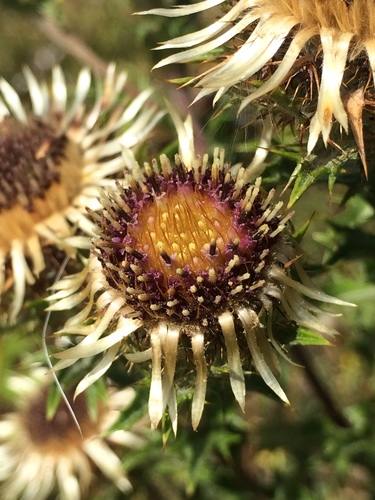
Carlina is a genus of about 30 species of spiny biennial and perennial thistles in the daisy family, Asteraceae, native to Europe, North Africa, and western and central Asia. Plants form a basal rosette of stiff, deeply lobed, spine-edged leaves and stand from nearly stemless up to 2-3 ft (60-90 cm) tall in the taller species. The flower heads are the chief feature: broad, flattened discs of many small tubular florets ringed by stiff, papery, straw-colored to silvery bracts that spread like rays. These dry bracts are hygroscopic, opening in dry air and closing as humidity rises, and they persist long after the florets fade. In the stemless C. acaulis a single silvery head 2-4 in (5-10 cm) across sits almost flat on the rosette, while C. vulgaris carries smaller heads on branched stems. Flowering runs through summer into early autumn. Carlina grows in dry grassland, on limestone and rocky alpine slopes, and on poor sandy soils, needing full sun and sharp drainage. It fails in rich, wet, or shaded ground, and the spiny foliage makes handling and weeding around it awkward.
Native Range
Carlina is native to Europe, North Africa, and western and central Asia, reaching from lowland grassland to subalpine and alpine slopes. Species grow on dry, open, often calcareous soils in pastures, heath, rocky outcrops, and mountain meadows.Suggested Uses
Carlina is grown in rock gardens, gravel and scree beds, dry sunny borders, and wildflower meadows on poor soils. The silvery, long-lasting heads are cut for dried and everlasting arrangements. The summer flowers draw bees and other pollinators to dry-garden plantings.How to Identify
Appearance
Size & Dimensions
Height2" - 3'
Width/Spread8" - 1'6"
Bloom Information
Carlina flowers from midsummer into early autumn, generally July to September, the florets opening within the persistent ring of bracts. The dried bracts hold their silvery color for months, lasting on the plant through winter. In the wild, individual rosettes of monocarpic species flower once and then die after setting seed.
Detailed Descriptions
Flower Description
straw-yellow to silvery-whiteFoliage Description
greenGrowing Conditions
Sun Requirements
Requires 6-12 hours of direct sunlight daily
• Full Sun: 6+ hours of direct sunlight
• Partial Shade: 3-6 hours of direct sunlight
• Full Shade: Less than 3 hours of direct sunlight
Care & Maintenance
Care Guide
Grow Carlina in full sun in gritty, sharply drained, lean soil, including chalky and rocky ground. Plants take drought, wind, and poor fertility once established but rot in rich, moist, or heavy clay soil, especially over winter. Sow seed where plants are to grow, since the long taproot transplants poorly after disturbance. Most species are hardy in USDA zones 5-8 and need no winter cover beyond sharp drainage. Young plants are watered during establishment and then left to dry conditions. The biennial and monocarpic species die after flowering, so some seed heads are left to self-sow for replacements.Pruning
Carlina needs no pruning. The dried flower heads are left in place for winter form or cut for everlasting arrangements, and spent rosettes of biennial species are cleared once they die after seeding. Removing some heads before the seed ripens limits self-sowing.Container Growing
Suitable for container growing
Minimum container size: 2 gallons
