Image 1 of 23
1 / 23
Plant Reference
Cardiocrinum, Genus, giganteum, Species,
- Genus & species
giant Himalayan lily
Himalayan mountain range from Afghanistan and Pakistan east through Nepal, Bhutan, and the Sichuan and Yunnan provinces of China to Myanmar; moist temperate mountain forests at 6,000-12,000 feet (1,800-3,600 m) elevation
Overview
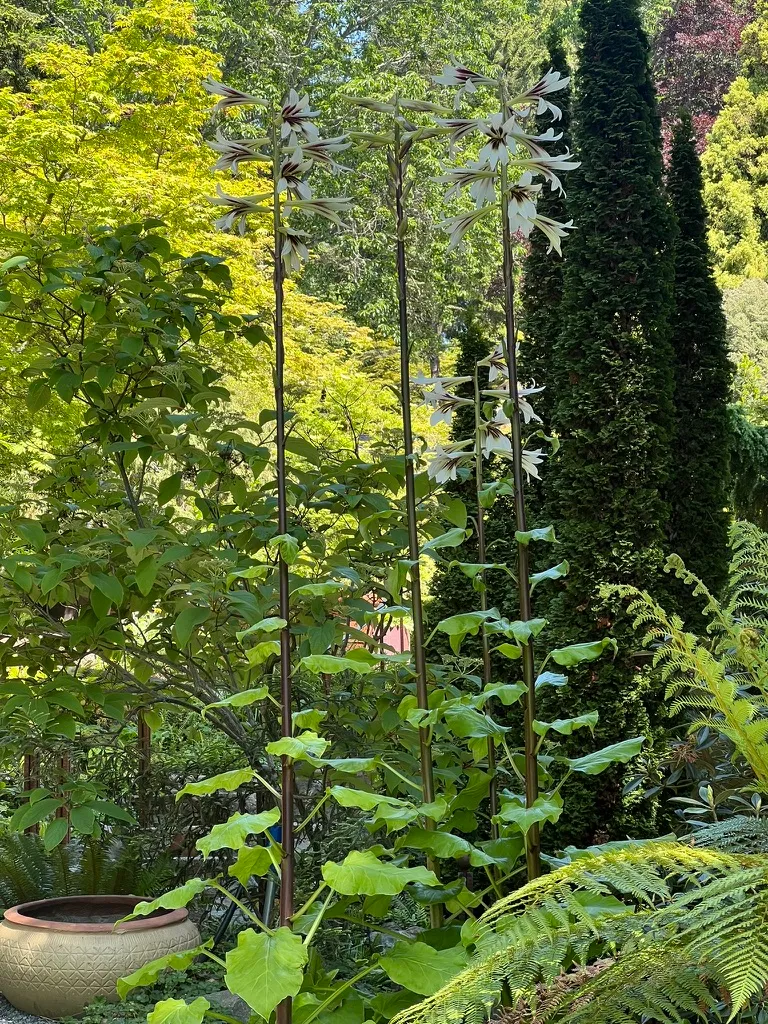
Cardiocrinum giganteum is a large bulbous perennial in the family Liliaceae native to the mountains of the Himalaya, growing 6-12 feet (1.8-3.6 m) tall on a single towering flowering stem when bloom-sized and 2-3 feet (0.6-0.9 m) wide at the base where the broad heart-shaped basal leaves carry the foliage mass. Leaves are broadly heart-shaped (cordate), glossy dark green, and 8-18 inches (20-45 cm) wide at their largest, arranged spirally up the flowering stem and in a basal rosette in non-flowering years — the cordate leaf shape is the source of the genus name Cardiocrinum (heart lily). Large white trumpet-shaped flowers 4-6 inches (10-15 cm) long open in terminal racemes of 10-20 flowers at the top of the flowering stem during July and August for approximately 4 weeks, held horizontally to pendant and marked internally with purple-red throat streaking that becomes visible when looking up into the flower. The flowers are strongly fragrant with a sweet heavy scent that carries across a woodland garden at dusk and is the main reason the species is grown despite its considerable cultivation demands. The central cultivation challenge is that the species is monocarpic — each individual bulb flowers only once in its life, and the main bulb dies after the flowering year. The death of the parent bulb is not the end of the plant because the flowering bulb produces offset bulblets at its base during the flowering season, and these offsets take 3-7 additional years to reach flowering size, with the result that a single bulb produces one bloom year followed by a multi-year gap before the offsets reach maturity. A garden group of bulbs of staggered sizes — flowering-sized plus one-year-old, two-year-old, and three-year-old offsets — is the standard approach for carrying a bloom each year rather than waiting through several lean years between flowering events. Bulbs are planted shallow with the tip at soil level rather than deeply buried; deep planting rots the bulbs. The species is native to moist temperate mountain forests at 6,000-12,000 feet (1,800-3,600 m) elevation in the Himalaya from Afghanistan east through Nepal, Bhutan, Yunnan, Sichuan, and Myanmar, where cool moist summers and deep humus-rich forest soils match its cultivation requirements — hot dry summer climates fail to satisfy the species. Slugs attack the young growth in spring and the emerging flower stem is vulnerable to slug damage during the 6-12 foot bolting phase. The species is not drought-tolerant and needs consistently moist humus-rich soil through the growing season. Bulbs are normally mulched in zones 6-7 for winter freeze protection. Toxicity is not well documented for humans and pets because the species is rarely eaten and the cultivation scale is small, though other members of Liliaceae are often toxic to cats. Deer browse foliage and flowers.
Native Range
Cardiocrinum giganteum is native to the Himalayan mountain range, with a range extending from northeastern Afghanistan and Pakistan east through Nepal, Sikkim, Bhutan, and the Sichuan and Yunnan provinces of China to northern Myanmar. The species grows in moist temperate mountain forests at 6,000-12,000 feet (1,800-3,600 m) elevation under beech, oak, rhododendron, and bamboo canopy, where cool moist summers, deep humus-rich forest soils, and high atmospheric humidity align with its requirements. The species was introduced to British horticulture during the 19th century through botanical expeditions to Sikkim and Nepal, and it has been grown in cool-climate woodland gardens of the British Isles, the Pacific Northwest, coastal New England, and similar maritime regions since that introduction — the summer climate of these regions comes closest to matching the Himalayan native conditions.Suggested Uses
Planted as a large specimen in moist shaded woodland gardens, cool-climate maritime gardens, and under deciduous tree canopy at 2-3 foot (0.6-0.9 m) spacing within groups of staggered bulb sizes in zones 6-9. The towering summer flowering stem, strongly fragrant white trumpet flowers, and heart-shaped basal foliage together make the species a centerpiece plant in cool-summer woodland garden compositions where the scale and the long wait for bloom suit the deliberate planting style. Combined with Hosta cultivars, Astilbe, ferns, and other moist-shade companions in woodland plantings where the companions fill the vertical space below the tall flowering stem. A group of bulbs of staggered sizes — flowering-sized, two-year offsets, and small bulblets — is planted together so that the colony produces a flowering event each year rather than concentrating all bloom in a single year followed by a long lean period. Not suited to hot-summer climates outside the cool maritime regions where summer heat exceeds the species tolerance, dry sites without consistent irrigation where moisture stress kills bulbs, sunny exposed positions where the foliage scorches, or small gardens where the 6-12 foot flowering stem height exceeds the scale of neighboring plantings.How to Identify
Appearance
Size & Dimensions
Height6' - 12'
Width/Spread2' - 3'
Colors
Bloom Information
Large white trumpet-shaped flowers 4-6 inches (10-15 cm) long open in terminal racemes of 10-20 flowers during July and August in zones 6-9, lasting approximately 4 weeks. Flowers are strongly fragrant with a sweet heavy scent that carries across the garden at dusk. Flowering occurs only once in each bulb's life because the species is monocarpic — the main bulb dies after flowering, and offset bulblets produced during the flowering year take 3-7 additional growing seasons to reach bloom size themselves. Gardeners planting a single bulb see one flowering year followed by 3-7 years of non-flowering growth while offsets mature, and a staggered-size bulb group is the standard approach for more continuous flowering across years.
Detailed Descriptions
Flower Description
white with purple-red throat streakingFoliage Description
glossy dark greenGrowing Conditions
Sun Requirements
Requires 2-5 hours of direct sunlight daily
• Full Sun: 6+ hours of direct sunlight
• Partial Shade: 3-6 hours of direct sunlight
• Full Shade: Less than 3 hours of direct sunlight
Care & Maintenance
Care Guide
Plant in consistently moist humus-rich soil with a pH of 5.5-7.0 in part shade (2-5 hours of direct sun) under deciduous woodland canopy where cool moist summer conditions and deep leaf-litter layers approximate the Himalayan native habitat. Bulbs are planted shallow with the tip at soil level rather than deeply buried; deep planting rots bulbs because Cardiocrinum bulbs do not tolerate the burial depths that true Lilium bulbs require. The species is not drought-tolerant and needs consistently moist soil through the growing season — dry summers cause premature flower drop and bulb decline. Water deeply once a week in rainfall-deficit periods. Slugs attack the young growth in spring and the emerging flower stem during bolting, and slug control through baiting, hand-picking, or beer traps is part of routine cultivation. The monocarpic habit means each bulb flowers only once and then dies, with offset bulblets taking 3-7 years to reach flowering size — planting a group of bulbs of different sizes is the standard approach for spreading the flowering event across years rather than concentrating it in a single year followed by a long gap. Offset bulblets are marked after the parent bulb dies so they can be left undisturbed during subsequent garden work. Bulbs benefit from winter mulching in zones 6-7 for freeze protection, and the species is not reliable outside the maritime-influenced regions of zones 6-9 where summers stay cool and moist. Toxicity for humans and pets is not well documented, though other members of Liliaceae are often highly toxic to cats — cat-owning households should treat the species as potentially hazardous until better data exists. Deer browse foliage and flowers readily.Pruning
The spent flowering stem is left standing through fall to carry the large upright seed capsules that develop after bloom, and the capsules are removed in October or November once they have matured or the whole stem has browned. The dead parent bulb is dug out and discarded after the flowering year because it will not flower again, and the offset bulblets at the base of the old bulb are left undisturbed in place rather than transplanted, so that they continue growing toward flowering size with minimal root disturbance. The offset positions are marked with a plant label or stake to prevent accidental disturbance during other garden work in the 3-7 year wait period before the next flowering event.Pruning Schedule
Prune: October–November
fall